
Editor's Note: This article has been faithfully transcribed from the original Beyond the Veil Magazine, Issue #56.
Archive Reference: BTV-056-01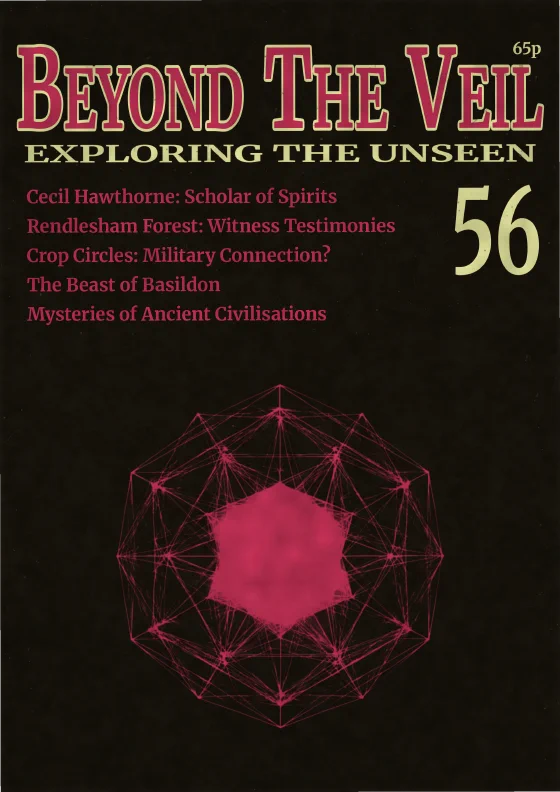
The Scholar of Spirits: Cecil Hawthorne
Issue #56: August 1983
The Victorian medium who walked the line between science and the supernatural
In the dimly lit salons of Victorian London, where parlours doubled as portals to the unknown, one name stood above the rest: Cecil Hawthorne. A spiritualist medium of rare intellect, Hawthorne’s séances drew the elite of British society, not for mere parlour tricks, but for what some described as “a communion with the beyond, imbued with scholarly rigour.”
Unlike the theatrical mediums of his time, who relied on flickering candlelight and hidden accomplices, Hawthorne conducted his séances in fully illuminated rooms, challenging sceptics to witness his work firsthand. To many, he was not merely a conduit for the departed, he was a philosopher of the unseen.
Early life
Born in 1842 into a household that bridged academia and mysticism, Cecil Hawthorne’s destiny seemed written in the stars, or by unseen hands. His father, a Cambridge scholar, nurtured his intellectual prowess, while his mother, a skilled cartomancer, introduced him to the unseen forces that would shape his future.
A child seer
At the age of nine, he made his first documented prediction: foretelling the devastating Great Fire of Newcastle and Gateshead in 1854. Witnesses recalled how young Hawthorne spoke of “a river alight with sorrow” days before the inferno reduced entire streets to cinders. This chilling accuracy earned him a reputation as a child seer.
Educated at Harrow School, Hawthorne was known for his keen intellect and an uncanny ability to locate lost objects in trancelike states. He formed an informal philosophical society where students debated emerging ideas in science, spirituality, and the occult, foreshadowing the role he would later play in Victorian spiritualist circles.
The rise of a medium
By the 1860s, whispers of a remarkable young medium reached London’s elite. Unlike the flamboyant frauds of the time, Hawthorne conducted séances in fully illuminated rooms, insisting on transparency.
His intimate readings at the British Museum’s reading room drew great thinkers, including Thomas Carlyle and even Prince Leopold, each seeking wisdom from beyond the veil. His reputation soon extended beyond Britain, attracting inquiries from European nobility and American intellectuals intrigued by his methods. Many claimed that his insights revealed knowledge no living person could have known, further intensifying the mystery surrounding his abilities.
The bhikkhu’s gift
Among his many spiritual tools, none was as famed as the Emerald Oracle, a radiant green pendulum used by Hawthorne to contact spirits and seek guidance. It was used alongside the Mudrikā: a stolen temple token able to judge the moral integrity of those in its presence.
Hawthorne often spoke of the mysterious circumstances surrounding their acquisition. In 1864, during an expedition to India, he had met a dying Buddhist bhikkhu who entrusted him with two items: a pendulum with a crystal of deep green, alive with an inner glow that pulsed as if breathing, and a small clay temple token depicting the Buddha in meditation. The monk revealed that he had stolen both items as a young novice. Though the theft had gone unnoticed, his life had been plagued by visions, illness, and inexplicable misfortune.
The bhikkhu’s final words to Hawthorne were chilling: “This stone carries the trapped light of a thousand souls. These items were taken from the temple, and their bearer must carry their burden.” He believed the relics bore a karmic resonance, the accumulated weight of centuries of devotion, suffering, and spiritual energy. The Mudrikā, he confessed, acted as a kind of moral ledger, while the Emerald Oracle was a vessel of divine witness.
Convinced that the artefacts carried both burden and blessing, the bhikkhu had sought someone worthy of their power. Hawthorne, moved by the monk’s words and humbled by the responsibility, accepted both the Oracle and the Mudrikā, two objects that would become central to his most profound spiritual investigations.
A séance like no other
One of the most extraordinary events in Hawthorne’s career occurred in 1882 during a séance at his Russell Square townhouse. Among the attendees were Lady Somerset, Lord Brentwood, and several noted scholars. The evening had begun as any other séance, with hushed voices and flickering candlelight, but as soon as Hawthorne lifted the Emerald Oracle, the room was bathed in an eerie green glow.
The pendulum’s radiance swelled until the very walls seemed to shimmer. Witnesses described the air as charged, thick with unseen presence. Then, as the room fell into silence, shadowy figures began to emerge. A procession of ethereal entities, some clear as living beings, others faint as mist, moved through the room.
Lady Somerset later wrote in her diary: “the light seemed alive, as though it pulsed with the rhythm of unseen forces.”
For days after, guests reported vivid dreams and an unshakable sense of having been seen by something beyond their understanding.
The vanishing of the Emerald Oracle
Hawthorne’s death in 1899 marked the end of an era in Victorian spiritualism, but one mystery remained: the fate of the Emerald Oracle and the Mudrikā. When his estate was catalogued, they were nowhere to be found.
In 1902, a private collector claimed to have acquired both items at an underground auction. As he unveiled the Oracle before a small gathering, the room filled with eerie green light pulsing with an intensity that left attendees entranced. Though they were never displayed again, whispered accounts suggest the artefacts remained in the collector’s possession, hidden from the public eye, their power, perhaps, too great for any one individual to control.
A legacy beyond parlour tricks
Cecil Hawthorne’s life and work challenged the limits of human understanding. He sought to elevate spiritualism beyond parlour tricks, inviting scientific scrutiny where others feared it. His work bridged the realms of logic and mysticism, leaving behind a legacy that continues to captivate seekers of the unknown.
Was Hawthorne truly in touch with forces beyond comprehension? Or was he merely a man of rare intellect and perception? Perhaps, even now, he watches from the beyond, ever the scholar of spirits, waiting for the next inquiring mind to reach through the veil. Some say his presence lingers in the echoes of dimly lit parlours, in the pages of his forgotten manuscripts, and in the flickering candlelight of séances still held in his name. If one dares to call upon him, will the Emerald Oracle glow once more, revealing a truth long buried in the shadows of time?