

Editor's Note: This article has been faithfully transcribed from the original Beyond the Veil Magazine, Issue #54.
Archive Reference: BTV-054-02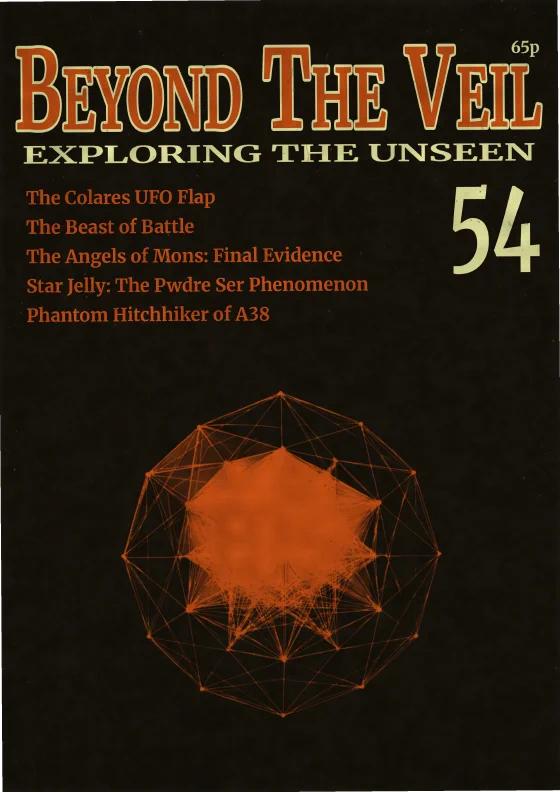
The Angels of Mons: Final Evidence
Issue #54: June 1983
In August 1914, the British Expeditionary Force faced the advancing German army at Mons, Belgium. Vastly outnumbered, the British conducted a fighting retreat. According to legend, they were protected by supernatural intervention: the Angels of Mons.
Nearly seventy years later, the debate continues. Did angels truly appear at Mons, or was the story pure fiction?
The Retreat
The Battle of Mons began on August 23, 1914. The British Expeditionary Force, approximately 80,000 men, faced a German force of 160,000. Despite inflicting heavy casualties on the attackers, the British were forced to retreat.
The retreat from Mons was brutal. For days, exhausted soldiers marched southward, fighting rearguard actions, sleeping in ditches, and suffering steady casualties.
It was during this retreat that the angels allegedly appeared.
The Story
According to the legend, phantom bowmen, or angels, or saints on horseback appeared in the sky above the retreating British forces. The supernatural beings shielded the soldiers from German fire. Enemy horses reared and fled. German soldiers died without visible wounds.
The story spread rapidly. By 1915, it was widely believed in Britain. Soldiers returning from the front told of miraculous intervention. The Angels of Mons became a symbol of divine protection.
The Origin
The story appears to have originated with Arthur Machen, a Welsh author of supernatural fiction. In September 1914, he published “The Bowmen,” a short story in the London Evening News.
In Machen’s story, British soldiers at Mons invoke St. George. Phantom bowmen appear and cut down the advancing Germans.
Machen intended the story as fiction. But readers took it as fact. The story spread, changing as it went: bowmen became angels, one saint became many.
Machen repeatedly stated that he had invented the story. He produced no sources, cited no witnesses, claimed no special knowledge. It was pure fiction.
The Witnesses
But as the legend spread, witnesses emerged.
Soldiers claimed to have seen the angels themselves. Nurses claimed to have heard accounts from wounded men. Chaplains collected testimony from multiple sources.
Were these witnesses remembering events, or were they remembering the story?
Human memory is malleable. Once the Angel legend was established, soldiers might have interpreted unusual experiences, or simply invented memories, to fit the narrative.
But the sheer volume of testimony is striking. Could all the witnesses have been mistaken or lying?
The Investigations
Several investigations have examined the evidence:
Society for Psychical Research (1915): Investigated reports and found no first-hand witnesses. All accounts were second-hand or later.
Harold Begbie (1915): Collected testimonies in his book “On the Side of the Angels,” though critics noted his accounts were also second-hand.
Contemporary Records: No German records mention supernatural intervention, dead soldiers without wounds, or horses panicking at invisible enemies.
The evidence for the Angels of Mons is entirely testimonial, collected after the legend had already spread.
Possible Explanations
Machen’s Fiction: The simplest explanation is that Machen invented the story, and it was adopted as fact by a public desperate for comfort during a terrible war.
Collective Hallucination: Exhausted, frightened soldiers might have experienced shared hallucinations. The stress of combat can produce extraordinary perceptions.
Atmospheric Phenomena: Unusual cloud formations, reflections, or mirages might have been interpreted as supernatural beings.
Genuine Miracle: Despite the lack of evidence, some believe divine intervention occurred. Absence of proof is not proof of absence.
The Significance
Whether real or invented, the Angels of Mons served a purpose. The story comforted a nation at war. It suggested that God favoured the Allied cause. It gave meaning to the suffering.
Legends often emerge in times of crisis. They express hopes and fears that facts cannot address. The Angels of Mons may say more about human need than about supernatural reality.
Conclusion
After nearly seventy years, no credible first-hand evidence for the Angels of Mons has been found. The story appears to have originated as fiction and spread as rumour.
Yet the legend persists. It has become part of the Great War’s mythology, alongside the Christmas Truce and the poppies of Flanders.
Perhaps that is enough. Perhaps the Angels of Mons are true in a way that transcends historical evidence. They represent the hope that, in humanity’s darkest hours, we are not alone.
The soldiers who fought at Mons are almost all gone now. The truth, if there is one, has likely passed with them.
The Angels remain, as legends do, beyond our reach.
Readers with family connections to Mons veterans are invited to share any accounts with our research department.