

Editor's Note: This article has been faithfully transcribed from the original Beyond the Veil Magazine, Issue #49.
Archive Reference: BTV-049-02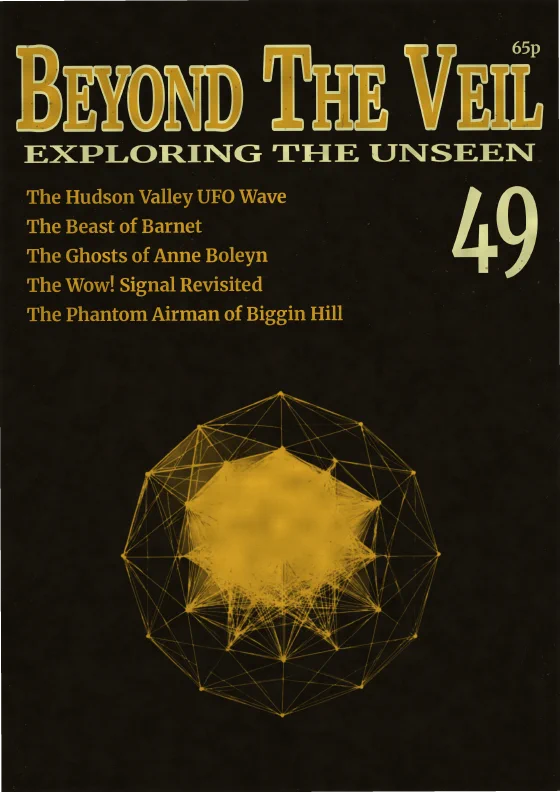
The Ghosts of Anne Boleyn
Issue #49: January 1983
Anne Boleyn was executed on May 19, 1536, accused of adultery, incest, and treason against her husband, King Henry VIII. She was thirty-five years old and had been queen for barely three years.
In the 447 years since her death, Anne has become Britain’s most frequently sighted ghost. She appears at the Tower of London, at Hever Castle, at Blickling Hall, and at numerous other locations associated with her brief, brilliant, tragic life.
The Tower of London
Anne was beheaded on Tower Green, within the walls of the Tower of London. She was buried in the Chapel of St. Peter ad Vincula, in an unmarked grave beneath the altar.
Her ghost has been seen in the Tower since at least the nineteenth century:
1864: A guard observed a figure in white walking on Tower Green. When challenged, the figure advanced toward him. The guard thrust his bayonet through the apparition, which continued forward before vanishing. The guard was found unconscious and was later court-martialled for dereliction of duty. He was acquitted when two other guards testified to having seen the same figure.
1933: A guard reported seeing a headless woman walking toward the Chapel Royal. He challenged her, received no response, and watched as she walked through a closed door.
1960s: A sentry reported a female figure in Tudor dress walking along the battlements before disappearing through a wall.
Anne is most often seen near the Chapel of St. Peter ad Vincula, where she is buried, and on Tower Green, where she died.
Hever Castle
Hever Castle in Kent was Anne’s childhood home. Here she grew up, here she was wooed by Henry VIII, and here her ghost returns.
Staff and visitors report:
- A figure in blue walking beneath the chestnut tree where Anne allegedly met Henry
- Unexplained footsteps in the bedroom she occupied as a girl
- A female presence felt in the gallery and great hall
- Cold spots that move through the castle without apparent cause
Anne’s ghost at Hever seems benign, a memory rather than a haunting. She walks the grounds she knew in life, returning to happier times before her marriage brought her to ruin.
Blickling Hall
Blickling Hall in Norfolk may be the site of Anne’s most dramatic manifestation. Though she was not born there (contrary to some legends), the Boleyn family owned the estate, and Anne certainly knew it.
Each year on May 19, the anniversary of her execution, a phantom coach approaches Blickling Hall. The coach is drawn by headless horses. A headless coachman holds the reins. And inside sits Anne Boleyn, her severed head in her lap.
The coach drives up the avenue, passes through the gates, and vanishes at the hall itself. Witnesses describe an atmosphere of intense cold and dread as the phantom approaches.
This tradition has been reported for centuries. Multiple witnesses, unknown to each other, have described the same phenomenon.
Rochford Hall
Rochford Hall in Essex was another Boleyn property. Anne’s ghost has been reported there, walking through walls that were once doorways and appearing in rooms that no longer exist in their original form.
The phenomenon suggests that ghosts may follow the architecture they knew in life rather than current structures. Anne walks through a Rochford Hall that exists only in the past.
Windsor Castle
Less well-documented sightings have been reported at Windsor Castle, where Anne occasionally resided during her marriage. A female figure in Tudor dress has been observed in the Dean’s Cloister, though identification as Anne specifically is uncertain.
The Pattern
Anne’s appearances share common features:
- She is seen most often on or near May 19, the anniversary of her death
- She typically appears in blue or white, the colours she was said to wear
- She is sometimes headless, sometimes whole
- She does not interact with the living but walks fixed routes
- She appears in locations associated with her life, not random sites
These patterns suggest that Anne’s ghost, if genuine, may be a recording rather than a conscious spirit. She replays the same scenes, walks the same paths, without awareness of observers.
Why Anne?
Why should Anne Boleyn be Britain’s most frequently sighted ghost?
She died unjustly, executed on charges most historians believe were fabricated. The trauma of her death may have created an impression strong enough to persist across centuries.
She was queen, famous in her time and remembered ever since. Perhaps collective memory and expectation create conditions favourable for sightings.
Or perhaps Anne’s restless spirit genuinely cannot find peace. She was denied a proper funeral. Her grave was unmarked for centuries. Her daughter Elizabeth eventually became queen, but Anne never lived to see it.
Whatever the reason, Anne Boleyn continues to walk. The sites she knew in life remain haunted by her memory. And each May 19, the phantom coach approaches Blickling Hall, carrying its headless queen home.
Readers who have encountered Anne Boleyn’s ghost are invited to contact our research department.