

Editor's Note: This article has been faithfully transcribed from the original Beyond the Veil Magazine, Issue #46.
Archive Reference: BTV-046-02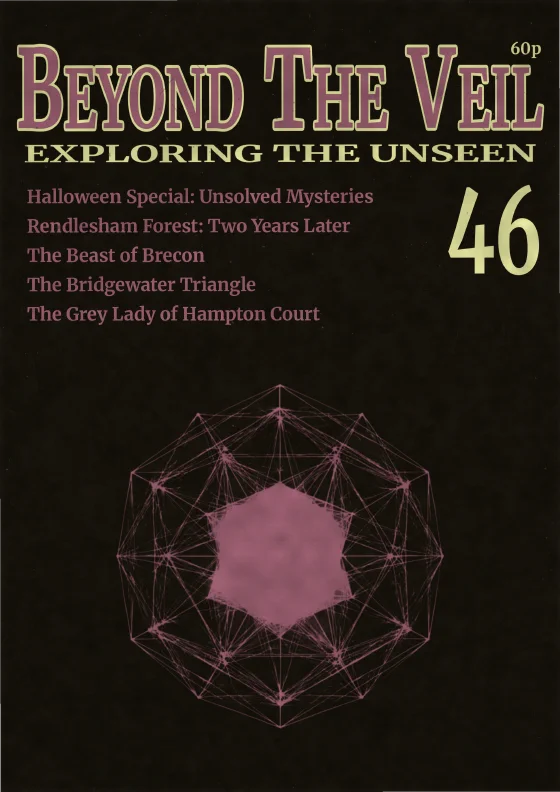
The Bridgewater Triangle
Issue #46: October 1982
In southeastern Massachusetts, an area of approximately two hundred square miles has become synonymous with unexplained phenomena. The Bridgewater Triangle, as it has been known since the 1970s, encompasses the towns of Abington, Rehoboth, and Freetown and has been the site of UFO sightings, cryptid encounters, and paranormal activity for centuries.
The Geography
The triangle’s geography contributes to its reputation. At its heart lies the Hockomock Swamp, an eight-thousand-acre wetland that Native Americans called “the place where spirits dwell.” The swamp is difficult to navigate, prone to fog, and home to unusual wildlife.
Surrounding the swamp are areas of forest, abandoned settlements, and old industrial sites. The landscape feels forgotten, as though time moves differently there.
Native American History
The Wampanoag people considered the Hockomock Swamp sacred and forbidding. They believed it was inhabited by spirits and advised against entering.
During King Philip’s War in the 1670s, the swamp served as a refuge for Native American warriors. The violence and death that occurred in and around the swamp have led some researchers to suggest that the area is “charged” with psychic energy from that traumatic history.
The Phenomena
The Bridgewater Triangle hosts an extraordinary variety of unexplained phenomena:
UFOs: Since the 1760s, residents have reported strange lights in the sky above the swamp. In 1968, a series of sightings near Rehoboth attracted national attention. Witnesses described disc-shaped objects, triangular craft, and brilliant lights that manoeuvred in ways no conventional aircraft could match.
Thunderbirds: Multiple witnesses have reported enormous birds with wingspans of eight to twelve feet. The descriptions match Native American legends of giant avian predators.
Bigfoot: Large, ape-like creatures have been reported in the forests around the swamp since at least the 1970s. Witnesses describe a creature seven to eight feet tall, covered in dark hair, with a powerful stench.
Black Dogs: Phantom dogs with glowing red eyes have been seen throughout the triangle, particularly on lonely roads at night. Some researchers connect these sightings to European traditions of the Black Dog as an omen of death.
Ghost Lights: Mysterious lights appear in the swamp itself, hovering over the water and moving through the trees. These might be will-o’-the-wisps, natural phenomena caused by decomposing vegetation, but witnesses describe intelligent behaviour.
Mutilated Animals: Cattle, goats, and other livestock have been found dead under mysterious circumstances, with precise wounds that suggest surgical instruments rather than predators.
Cults and Rituals: Evidence of ritualistic activity has been found in the Freetown-Fall River State Forest. Animal sacrifices, strange symbols, and abandoned altars suggest that humans have contributed to the triangle’s dark reputation.
The Investigations
Researchers have studied the Bridgewater Triangle for decades. Loren Coleman, a cryptozoologist who grew up in the area, has documented cases since the 1960s. His work identified the pattern of phenomena that defines the triangle.
Police and wildlife officials have investigated individual incidents without reaching satisfying conclusions. The phenomena are too varied, too sporadic, and too strange for conventional investigation.
Theories
Several theories attempt to explain the concentration of phenomena:
Geological Factors: The region contains unusual rock formations and mineral deposits. Geomagnetic anomalies might affect human perception or attract phenomena from elsewhere.
Psychic Residue: The violence of King Philip’s War and subsequent tragedies might have left a permanent mark on the landscape. Trauma, some theorists suggest, can be stored in places.
Convergence Point: The triangle might be a place where different realities intersect. UFOs, cryptids, and ghosts might all be visitors from adjacent dimensions.
Cultural Amplification: Once an area develops a reputation for strangeness, observers may interpret ambiguous experiences as supernatural. The reputation becomes self-fulfilling.
The Experience
Visitors to the Bridgewater Triangle often report a sense of unease. The fog that rises from the Hockomock Swamp creates an otherworldly atmosphere. The forests are dark and silent. The roads are lonely.
Whether the phenomena are genuine or the product of expectation, the experience is real. People feel watched. They hear sounds that should not exist. They see things that cannot be explained.
The Bridgewater Triangle is not merely a collection of strange reports. It is a place that feels wrong, a region where the normal rules seem not to apply.
Conclusion
Two hundred square miles of Massachusetts have become synonymous with the unexplained. For centuries, residents and visitors have encountered phenomena that defy rational explanation.
The Bridgewater Triangle may be a genuine anomaly, a place where the boundaries between worlds are thin. Or it may be a lesson in the power of expectation and folklore.
Either way, it remains one of the most intensively studied paranormal regions in America. And the reports continue to accumulate.
Readers who have experienced phenomena in the Bridgewater Triangle are invited to contact our research department.