

Editor's Note: This article has been faithfully transcribed from the original Beyond the Veil Magazine, Issue #38.
Archive Reference: BTV-038-02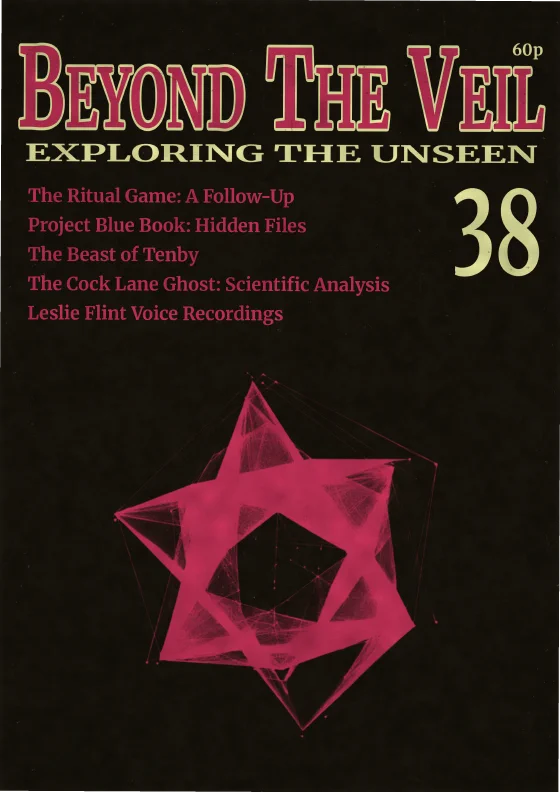
Project Blue Book: The Hidden Files
Issue #38: February 1982
For twenty-two years, from 1947 to 1969, the United States Air Force officially investigated unidentified flying objects. Project Blue Book, as the programme was known, examined over 12,600 reported sightings. When it closed, the Air Force declared that UFOs posed no threat to national security and warranted no further study.
But the full story is more complex.
The Origins
Project Blue Book was the third official UFO investigation conducted by the US Air Force. It was preceded by Project Sign (1947-1949) and Project Grudge (1949-1951). Each programme was ostensibly designed to investigate sightings and determine whether UFOs represented a security threat.
Project Sign’s investigators initially concluded that some UFOs were likely extraterrestrial in origin. This conclusion was rejected by senior Air Force officials, and the programme was reorganised as Project Grudge with a more sceptical mandate.
By the time Project Blue Book was established in 1952, the official position was that UFOs were either misidentifications of conventional phenomena or products of imagination. The programme’s primary function, critics argue, was to debunk rather than investigate.
The Investigations
Project Blue Book investigated sightings across the United States. Cases ranged from obvious misidentifications (Venus, weather balloons, aircraft) to genuinely puzzling encounters that resisted explanation.
The programme was headquartered at Wright-Patterson Air Force Base in Ohio. For most of its existence, it was staffed by a handful of officers with limited resources. The entire investigation was run on a shoestring budget.
Captain Edward J. Ruppelt, who headed the project from 1951 to 1953, took the work seriously. He coined the term “unidentified flying object” to replace the sensationalist “flying saucer.” He investigated cases thoroughly and was genuinely puzzled by some of what he found.
But after Ruppelt’s departure, the programme became increasingly focused on explaining away sightings rather than investigating them objectively.
The Robertson Panel
In January 1953, the CIA convened a secret panel of scientists to review the UFO evidence. The Robertson Panel, named for its chairman, physicist H.P. Robertson, met for five days and examined the best available cases.
Their conclusion was remarkable: not that UFOs were imaginary, but that public interest in UFOs was dangerous. The panel recommended that the government actively debunk UFO sightings to reduce public concern. They suggested monitoring civilian UFO groups for subversive elements.
The Robertson Panel’s recommendations shaped Project Blue Book’s subsequent approach. The programme became less about investigation and more about public relations.
The Condon Committee
By the late 1960s, Project Blue Book was widely criticised. Believers accused it of covering up evidence. Sceptics questioned whether it served any purpose.
In 1966, the Air Force commissioned a study by the University of Colorado, headed by physicist Edward Condon. The Condon Committee examined selected cases and ultimately concluded that further study of UFOs was unlikely to yield scientific results.
This conclusion was controversial. Condon himself was openly dismissive of UFO witnesses, calling them “kooks and cranks.” Some committee members resigned in protest, arguing that the investigation was biased from the start.
The Condon Report, published in 1968, provided the Air Force with the justification it needed. Project Blue Book was closed in December 1969.
The Unexplained Cases
Project Blue Book categorised each case as “identified” or “unidentified.” By its closure, 701 cases remained officially unidentified: approximately 5.5 percent of all cases investigated.
These cases included:
The Levelland Sightings (1957): Multiple independent witnesses in Texas reported a glowing, egg-shaped object that caused vehicle engines and lights to fail as it passed.
The RB-47 Encounter (1957): A US Air Force reconnaissance aircraft was followed by a UFO for over an hour across several states. The object was detected on airborne radar and ground stations.
The McMinnville Photos (1950): Two photographs taken by a farmer in Oregon showed a disc-shaped object. Photo analysts have never conclusively explained them.
The Socorro Incident (1964): A police officer in New Mexico encountered a landed egg-shaped craft with two occupants. Physical traces were found at the site.
These cases were not explained. They were simply filed and forgotten.
What Did They Know?
The question remains: what did Project Blue Book’s investigators actually believe?
Some, like Ruppelt, appeared genuinely uncertain. Others, like Major Hector Quintanilla, who ran the project in its final years, were openly dismissive.
But the programme’s limitations were severe. Investigators had little time, few resources, and strong pressure to find conventional explanations. Cases that could not be explained were often simply labelled “insufficient data” and set aside.
Whether Project Blue Book concealed genuine evidence of extraterrestrial contact or simply failed to investigate rigorously, the truth remains elusive. The programme’s files have been released to the public, but they raise as many questions as they answer.
The era of official UFO investigation in America has ended. But the phenomena continue.
Readers with access to documents related to Project Blue Book or similar programmes are invited to contact our research department.