

Editor's Note: This article has been faithfully transcribed from the original Beyond the Veil Magazine, Issue #36.
Archive Reference: BTV-036-02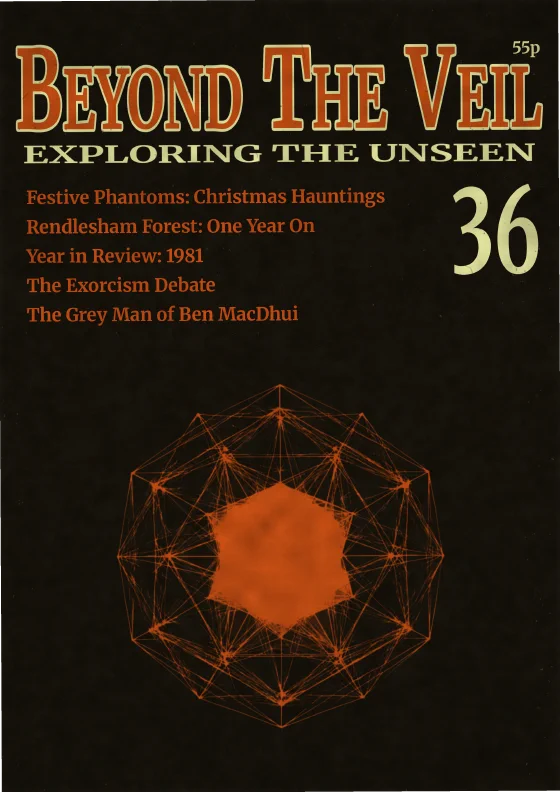
The Grey Man of Ben MacDhui
Issue #36: December 1981
Ben MacDhui, the second-highest mountain in Britain, stands in the heart of the Cairngorms. Its summit plateau is a desolate place: boulder fields, patches of snow, and mist that can descend without warning. It is also the home of something that should not exist.
The Fear Liath Mor, the Big Grey Man, has stalked this mountain for at least a century. Experienced mountaineers, scientists, and hardy Scots have encountered him and fled in terror.
The First Account
The first public account came from Professor J. Norman Collie, a respected chemist and mountaineer, who spoke to the Cairngorm Club in 1925. He described an experience from 1891:
“I was returning from the cairn on the summit in a mist when I began to think I heard something else than merely the noise of my own footsteps. For every few steps I took, I heard a crunch, and then another crunch as if someone was walking after me but taking steps three or four times the length of my own.”
Collie was not a man given to fancy. He waited, listening. The footsteps continued. Terror seized him.
“I was seized with terror and took to my heels, staggering blindly among the boulders for four or five miles nearly down to Rothiemurchus Forest.”
For thirty years, Collie said nothing of his experience, fearing ridicule. He spoke only when he learned that others had encountered the same phenomenon.
Other Witnesses
Peter Densham, an aircraft rescue worker who patrolled Ben MacDhui during the Second World War, reported multiple encounters. He heard footsteps following him through the mist, felt an oppressive presence, and once glimpsed a dark figure on the edge of visibility.
Alexander Tewnion, a naturalist and experienced mountaineer, encountered the Grey Man in 1943. Visibility was clear, and he was alone on the summit. Suddenly, a huge grey figure charged at him from the mist. Tewnion drew his revolver and fired three shots at the figure before fleeing down the mountain.
Tom Crowley, a member of the Moray Mountaineering Club, heard the footsteps in the 1920s. He described the sound as rhythmic and purposeful, as though something walked deliberately behind him. He ran, and the footsteps pursued.
The Phenomenon
Witnesses describe several consistent elements:
Footsteps: The sound of enormous footsteps, widely spaced, following the observer through mist or darkness. The steps are unhurried, deliberate, relentless.
Presence: An overwhelming sense of being watched, accompanied by feelings of dread that verge on panic. Many witnesses describe this terror as unlike any fear they have experienced before.
The Figure: Some witnesses have glimpsed a tall, grey, humanoid shape. Estimates of its height range from ten to thirty feet. It is indistinct, as though seen through fog even when visibility is otherwise clear.
The Compulsion to Flee: Nearly all witnesses describe an irresistible urge to run. This is not ordinary fear but something closer to primal terror, a certainty that to remain is to die.
Explanations
Several theories have been proposed:
Optical Illusion: The Brocken spectre, a phenomenon where the observer’s shadow is projected onto mist and magnified, might account for the visual sightings. But it does not explain the footsteps or the terror.
Infrasound: Low-frequency sound, below the range of human hearing, can cause feelings of unease, dread, and even hallucination. Wind passing over the mountain’s features might generate such sounds.
Isolation and Exhaustion: High-altitude environments, combined with physical exhaustion, can produce hallucinations. The mountain’s isolation might amplify the sense of threat.
Shared Mythology: Once the Grey Man became known, witnesses might unconsciously interpret ambiguous experiences in light of the legend.
None of these explanations is wholly satisfying. The Brocken spectre does not walk with footsteps. Infrasound does not single out individual climbers. And the consistency of accounts across decades suggests something more than shared mythology.
The Legend
Scottish folklore includes many tales of mountain spirits. The bodach, a supernatural old man, haunts wild places. The sluagh, the host of the unforgiven dead, sweeps across the highlands. Perhaps the Grey Man is a manifestation of these ancient beliefs.
But the witnesses are not superstitious peasants. They are scientists, soldiers, experienced mountaineers: people trained to observe accurately and report honestly. Their terror was real. Their experiences were consistent.
The Mystery Remains
Ben MacDhui continues to attract climbers, and the Grey Man continues to appear. Recent accounts, while less publicised than the classic cases, suggest the phenomenon has not ceased.
What walks the summit plateau of Scotland’s second mountain? A projection of the human mind, generated by isolation and thin air? An undiscovered animal, glimpsed only in poor conditions? Something older, stranger, more fundamental?
The mountain keeps its secrets. The mist descends, and in the mist, something walks. Those who meet it rarely linger to investigate.
They run.
Readers who have experienced phenomena on Ben MacDhui or other Scottish mountains are invited to contact our research department.