
Editor's Note: This article has been faithfully transcribed from the original Beyond the Veil Magazine, Issue #35.
Archive Reference: BTV-035-02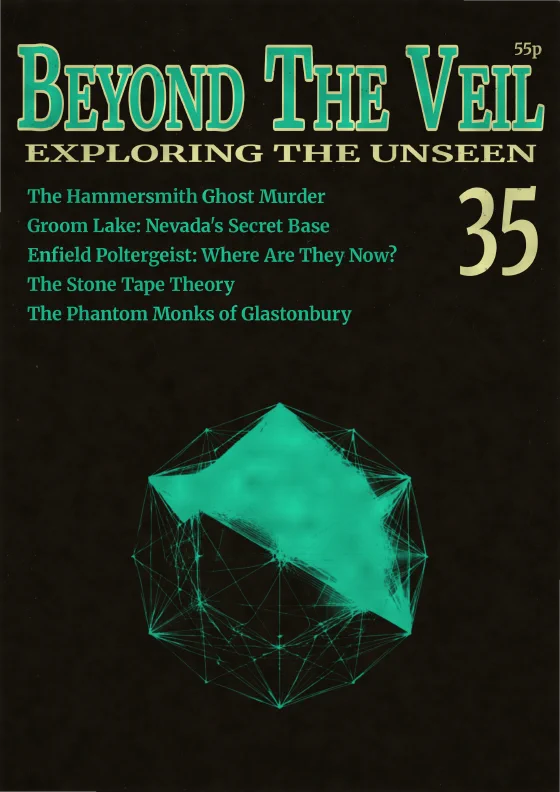
The Stone Tape Theory
Issue #35: November 1981
Why do ghosts walk the same routes, perform the same actions, appear in the same locations? Why do hauntings so often occur in old buildings, particularly those associated with violence or intense emotion?
The Stone Tape Theory offers a possible answer: what we call ghosts may not be spirits of the dead but recordings, stored in the very fabric of buildings, replaying endlessly like a film loop.
The Hypothesis
The Stone Tape Theory proposes that the fabric of buildings, particularly stone, can absorb energy from emotional events. Just as magnetic tape records sound, walls and floors might record the psychic energy of terror, grief, or rage.
Under the right conditions, these recordings might be replayed. A sensitive observer might perceive the stored event as an apparition, complete with visual and auditory components.
The ghost is not a spirit. It is a recording. It cannot interact with the living because it is not aware. It simply replays, over and over, until the recording finally degrades.
Origins of the Theory
The concept has roots in nineteenth-century psychical research. Early investigators noted that ghosts seemed to follow fixed patterns, suggesting they lacked the consciousness to deviate from their courses.
Thomas Charles Lethbridge, an archaeologist and psychical researcher, developed the idea further in the 1960s. He proposed that water might act as a recording medium, storing events that could be replayed under appropriate conditions.
The term “Stone Tape” was popularised by the 1972 BBC television play of the same name, written by Nigel Kneale. In the drama, scientists discover that stone walls have recorded an ancient death, which replays as a haunting.
The drama was fiction, but it articulated ideas that researchers had been developing for decades.
Supporting Observations
Several aspects of traditional hauntings support the Stone Tape hypothesis:
Repetitive Behaviour: Most ghosts are seen performing the same actions repeatedly. The Grey Lady walks the same corridor. The footsteps sound on the same staircase. If ghosts were conscious beings, we might expect more variation.
Anniversary Phenomena: Many hauntings occur on or near the anniversary of significant events. If hauntings are recordings, they might be triggered by environmental conditions that recur annually: temperature, humidity, magnetic field variations.
Location Specificity: Ghosts typically haunt specific locations rather than following individuals. If a ghost were a person’s spirit, why would it remain attached to a building? But a recording, by definition, is fixed to its medium.
Lack of Interaction: Many ghosts do not respond to observers. They walk through people, ignore questions, and vanish when confronted. They behave like recordings rather than conscious beings.
The Science
What physical mechanism could allow stone to record events?
Some researchers point to the crystalline structure of certain minerals. Quartz, found in granite and sandstone, exhibits piezoelectric properties: it generates electrical charges when subjected to stress. Perhaps strong emotion creates electromagnetic fields that affect crystalline structures.
Others suggest that water trapped in stone might play a role. Water molecules can form complex patterns that store information. The human body is largely water; perhaps intense emotion generates signals that are absorbed by water in surrounding materials.
These proposals are speculative. No laboratory experiment has demonstrated the recording of human emotion in stone. But the absence of proof is not proof of absence.
Implications
If the Stone Tape Theory is correct, several implications follow:
Ghosts Are Not the Dead: The apparitions we see are not souls of the departed. They are echoes, no more alive than a photograph or a recording.
Hauntings Are Natural Phenomena: There is nothing supernatural about Stone Tape hauntings. They are simply examples of a natural process we do not yet understand.
Recordings Can Be Erased: If hauntings are recordings, they might be erasable. Perhaps renovation disturbs the recording medium. Perhaps exorcism works through psychological mechanisms that affect the observer rather than the ghost.
New Buildings Will Accumulate Ghosts: If intense emotion creates recordings, then modern buildings will eventually become haunted. The theory predicts that hauntings should become more common over time, as more events are recorded.
Criticisms
Sceptics raise several objections:
No Physical Mechanism: Despite decades of speculation, no one has demonstrated how stone could record emotional events. The theory remains purely hypothetical.
Selection Bias: We notice hauntings in old buildings because we expect them there. Modern buildings may be just as haunted but go unnoticed.
Intelligent Hauntings: Some ghosts appear to interact with the living, answering questions, responding to presence, even communicating information unknown to the observer. These cases are difficult to explain as mere recordings.
A Working Hypothesis
The Stone Tape Theory does not explain all hauntings. Poltergeist phenomena, interactive apparitions, and crisis apparitions require different explanations.
But for the countless ghosts that walk unchanging paths through ancient buildings, the theory offers a coherent framework. It does not dismiss hauntings as imagination or fraud. It takes the evidence seriously while proposing a natural mechanism.
Perhaps, in time, science will develop instruments capable of detecting these recordings. Perhaps we will learn to read the stone tape as easily as we read magnetic tape today.
Until then, the theory remains what it has always been: a tantalising hypothesis, waiting for the evidence that will prove or disprove it.
Readers with observations relevant to the Stone Tape Theory are invited to contact our research department.