

Editor's Note: This article has been faithfully transcribed from the original Beyond the Veil Magazine, Issue #34.
Archive Reference: BTV-034-01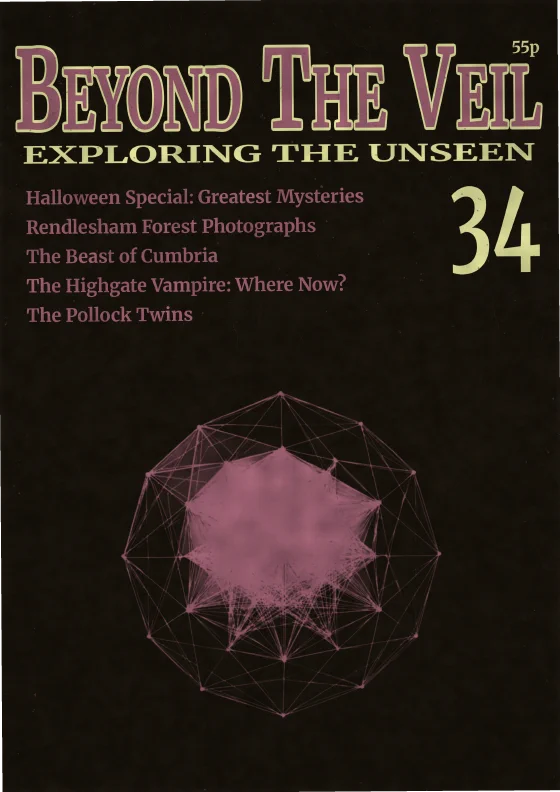
Halloween Special: Haunted Britain's Greatest Mysteries
Issue #34: October 1981
Some mysteries are solved. The perpetrator confesses, the science advances, the hidden truth emerges. But others resist every effort at explanation. They remain unsolved, decade after decade, century after century, haunting the imagination of each new generation.
This Halloween, we examine ten mysteries that have never been satisfactorily explained.
The Mary Celeste (1872)
The brigantine Mary Celeste was found drifting in the Atlantic on December 5, 1872, completely abandoned. The ship was seaworthy, with six months’ provisions aboard. The cargo was intact. The crew’s personal belongings remained in their quarters.
But Captain Benjamin Briggs, his wife, their two-year-old daughter, and the seven-man crew had vanished. The only lifeboat was missing. The ship’s log ended nine days before discovery.
No satisfactory explanation has ever been found. Theories range from piracy to waterspout to ergot poisoning, but none accounts for all the evidence. The Mary Celeste remains history’s most famous ghost ship.
The Flannan Isles Lighthouse (1900)
Three lighthouse keepers vanished from the Flannan Isles off the coast of Scotland in December 1900. When a relief vessel arrived, the lighthouse was dark. Inside, the clock had stopped. A meal sat uneaten on the table. The men were simply gone.
Their bodies were never found. The final log entry noted severe storms, but the weather on the island showed no signs of unusual violence. What could cause three experienced keepers to abandon their post?
The Hinterkaifeck Murders (1922)
In a remote Bavarian farmstead, six people were murdered with a mattock on March 31, 1922. The killer then lived in the house for several days, tending the livestock, eating the family’s food, sleeping in their beds.
The murders remain unsolved despite exhaustive investigation. The killer left no useful evidence. The victims were found stacked neatly in the barn, as though arranged by someone with time to spare.
Over one hundred suspects have been investigated. None has been proven guilty.
The Lead Masks of Vintem Hill (1966)
Two Brazilian electronic technicians were found dead on a hilltop near Niterói in August 1966. They wore formal suits and crude lead eye masks. Beside them lay a notebook with cryptic instructions about ingesting capsules at a specific time.
Autopsies were inconclusive. The capsules were never identified. The men appeared to have been conducting some kind of ritual, possibly related to contact with extraterrestrial beings.
What were they trying to do? What killed them? The questions remain unanswered.
The Dyatlov Pass Incident (1959)
Nine experienced hikers died in the Ural Mountains of Russia under inexplicable circumstances. They fled their tent in subzero temperatures, many without proper clothing. Some showed signs of massive internal trauma without external wounds. One woman was missing her tongue.
Soviet investigators concluded that an “unknown compelling force” had caused the deaths. Theories have ranged from avalanche to military testing to yeti attack. None fits all the evidence.
The Somerton Man (1948)
An unidentified man was found dead on Somerton Beach in Adelaide, Australia. His clothing labels had been removed. He carried no identification. A scrap of paper in his pocket bore the words “Tamám Shud,” Persian for “ended” or “finished.”
Despite global publicity, the man has never been identified. His fingerprints matched no records. A code found in a book linked to the case has never been deciphered. Who was he? How did he die? Why were such efforts made to conceal his identity?
The Zodiac Killer (1968-1969)
A serial killer terrorised the San Francisco Bay Area, murdering at least five people. He sent taunting letters and cryptograms to newspapers, claiming thirty-seven victims in total.
Despite thousands of tips, the Zodiac was never caught. One of his four ciphers remains unbroken. His identity is still unknown, though he may still be alive.
The Eilean Mor Keepers
We have covered the Flannan Isles case already in this publication, but it bears emphasis here. Three men vanished from a remote lighthouse, leaving behind evidence of panic and flight. The sea around the island was calm. No bodies were ever recovered.
Similar disappearances have occurred at lighthouses around the world. There is something about isolation, about standing watch at the edge of the world, that seems to invite tragedy.
The Voynich Manuscript
This medieval document, written in an unknown script and illustrated with bizarre botanical and astronomical diagrams, has resisted all attempts at decipherment. Is it a genuine record of lost knowledge? An elaborate hoax? The fever dream of a medieval mystic?
Cryptographers, linguists, and historians have studied the Voynich for decades. It yields nothing. Perhaps the truth is that it means nothing, that it was designed to resist understanding. Or perhaps we simply lack the key.
Roanoke Colony (1590)
Over a hundred English colonists vanished from Roanoke Island in the New World. When a supply ship returned after three years, the settlement was deserted. The word “CROATOAN” was carved on a post.
What happened to the Lost Colony of Roanoke? Did they join local tribes? Were they killed? Did they attempt to sail home and perish at sea?
Four hundred years later, we do not know.
The Nature of Mystery
These cases span centuries and continents. They involve ships, lighthouses, manuscripts, and murders. Yet they share a common quality: they resist the human need for answers.
Perhaps that is why they endure. We are pattern-seeking creatures. When no pattern emerges, we cannot let go. We return again and again to the evidence, hoping to find what previous investigators missed.
The unsolved mysteries haunt us because they remind us of our limitations. The universe keeps secrets. Some questions may never be answered.
But we keep asking. That is our nature too.
Readers with theories about any of these cases are invited to write to our research department.