
Editor's Note: This article has been faithfully transcribed from the original Beyond the Veil Magazine, Issue #33.
Archive Reference: BTV-033-01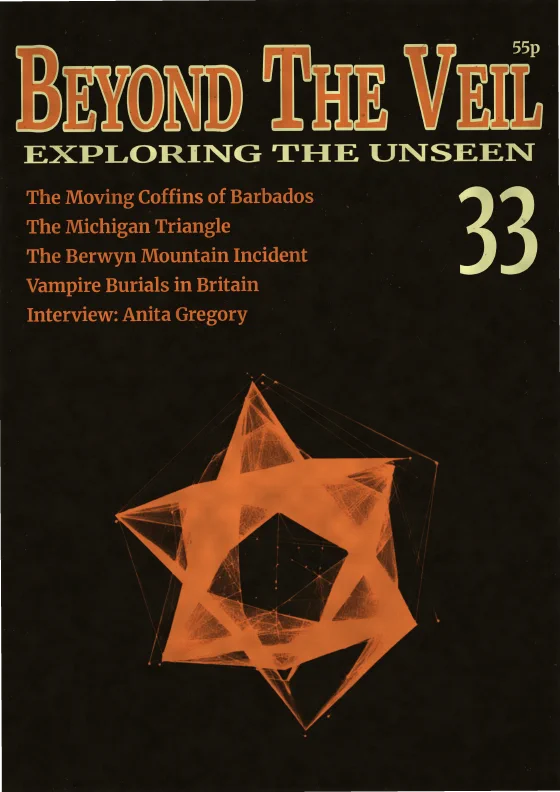
The Moving Coffins of Barbados
Issue #33: September 1981
In the graveyard of Christ Church Parish, Barbados, stands a stone vault cut into a hillside. The Chase family used this vault for burials from 1808 onward. Each time the vault was opened to receive a new coffin, those already interred had moved.
The coffins of the Chase family would not stay where they were placed.
The Vault
The vault was constructed in the early 1700s, carved from coral rock and sealed with a heavy stone slab that required several men to move. It was first used for the burial of Mrs. Thomasina Goddard in 1807 and then sold to the Chase family.
The Chases were a wealthy family, but not a happy one. Thomas Chase, the patriarch, was by all accounts a brutal man. When his daughter Dorcas died in 1808, aged two, rumours circulated that she had been starved. Another daughter, Mary Ann, died in 1812 at sixteen. Some believed she had taken her own life to escape her father.
Thomas Chase himself died on August 9, 1812. When the vault was opened to receive his coffin, the two small coffins already inside had moved. They were found scattered about the vault, one standing upright against the wall.
The Disturbances
Over the following years, the vault was opened repeatedly, and each time the coffins had shifted.
September 25, 1816: When the vault was opened for the burial of Charles Ames, all three Chase coffins were in disarray. Thomas Chase’s coffin, a heavy lead casket that required eight men to carry, had been thrown on its head.
November 17, 1816: The burial of Samuel Brewster found the coffins again disturbed. Despite the heavy stone seal showing no sign of tampering, the interior was in chaos.
July 17, 1819: Mary Ann Brewster’s burial revealed the same phenomenon. By now, the disturbances had attracted official attention.
Lord Combermere, the Governor of Barbados, ordered an investigation. The vault was examined. No secret passages or signs of entry were found. The coffins were carefully arranged, and sand was scattered on the floor to show footprints. The stone slab was sealed with the Governor’s personal mark.
The Final Opening
April 18, 1820: The vault was opened in the presence of Lord Combermere and numerous witnesses. The seals were intact. The heavy stone slab had not been moved.
Inside, the coffins were scattered across the vault. The sand on the floor showed no footprints. The only sign of disturbance was the coffins themselves, thrown about by some force that left no trace of its passage.
The Chase family removed the coffins and buried them elsewhere. The vault was never used again.
Explanations
Numerous theories have been proposed to explain the moving coffins:
Flooding: Some have suggested that water entering the vault during heavy rains caused the coffins to float and shift. The lead-lined Chase coffins would have been buoyant if sealed. But no water was found in the vault, and the sand in 1820 was undisturbed.
Earthquakes: Seismic activity might shift coffins within a sealed space. Barbados does experience tremors. But earthquakes severe enough to move lead coffins would have been felt and recorded, and none corresponded to the disturbances.
Gas Buildup: Decomposition gases accumulating in sealed coffins might cause them to move or explode. This theory fails to explain the consistent scattering pattern or why only the Chase vault was affected.
Human Intervention: Secret entry could explain the movement, though the 1820 examination found no means of secret entry, and the sealed sand remained undisturbed.
Supernatural Forces: Thomas Chase was an evil man who may have invited evil into his family’s resting place. The spirits of his abused daughters might seek to disturb his rest, or darker forces might claim his soul.
Similar Cases
The Chase vault is not unique. Similar phenomena have been reported elsewhere:
In Stanton, Suffolk, coffins in a private vault were repeatedly found disturbed in the eighteenth century. No explanation was found.
At Ahrensburg, Germany, horses interred in a church vault were found to have moved despite sealed doors.
In Baltic Estonia, coffins in a noble family’s vault were discovered scattered, some standing on end.
The pattern suggests a phenomenon that transcends individual locations. Whatever force moves coffins in sealed vaults may operate by rules we do not understand.
The Mystery Endures
The Chase vault in Barbados stands empty now, its heavy stone slab open to the sky. Visitors come to see the place where the dead refused to rest.
What happened there between 1812 and 1820 remains unexplained. The witnesses were reliable. The evidence was documented. The phenomenon was real.
Perhaps Thomas Chase’s cruelty drew something to the vault. Perhaps the victims of that cruelty fought back in the only way available to them. Or perhaps forces beyond our understanding sometimes intrude upon the world of the dead, reminding us that even in the grave, nothing is certain.
The coffins of Barbados have found other resting places. But the questions they raised still echo in the empty vault.
Readers with knowledge of similar phenomena in British churchyards are invited to contact our research department.