
Editor's Note: This article has been faithfully transcribed from the original Beyond the Veil Magazine, Issue #30.
Archive Reference: BTV-030-01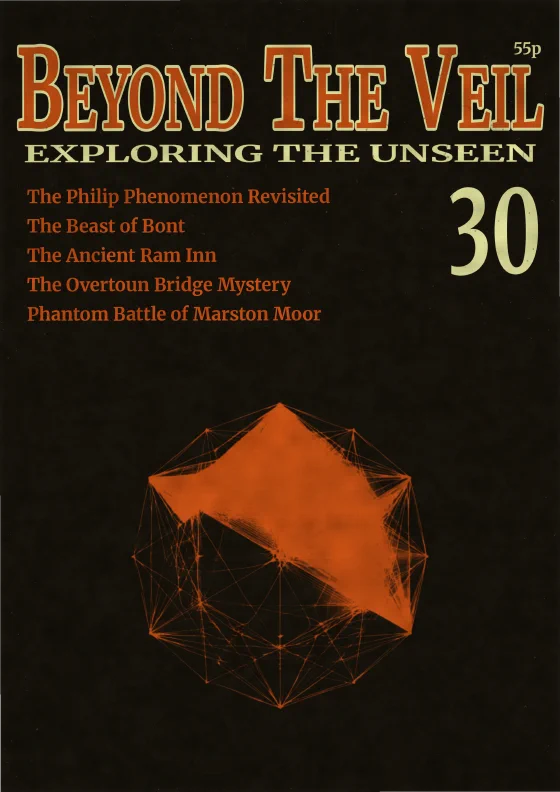
The Philip Phenomenon Revisited
Issue #30: June 1981
In 1972, a group of researchers in Toronto set out to create a ghost. They invented a fictional character, complete with biography and tragic death, and then attempted to contact him through seances. To their astonishment, the ghost they had created responded.
The Philip Experiment, as it became known, raises disturbing questions about the nature of hauntings and the power of collective belief.
The Toronto Society for Psychical Research
The experiment was conducted by members of the Toronto Society for Psychical Research under the direction of Dr. A.R.G. Owen, a mathematician, and his wife Iris Owen, who had studied mediumship and psychic phenomena. Their collaborators included scientists, psychologists, and lay researchers.
The group’s hypothesis was radical: if ghosts are manifestations of human consciousness rather than independent spirits, it should be possible to create one deliberately. They would invent a completely fictional person and see if they could make him “haunt.”
Creating Philip
The group developed an elaborate biography for their imaginary ghost. They named him Philip Aylesford, an English aristocrat from the seventeenth century. Philip was a Catholic supporter of King Charles I who had an affair with a Gypsy woman named Margo. When Margo was accused of witchcraft and burned at the stake, Philip did not intervene to save her. Consumed by guilt, he threw himself from the battlements of his home, Diddington Manor, in 1654.
The researchers invented physical details: Philip was tall, dark-haired, with a small moustache and dark eyes. They created a portrait of him. They discussed his personality, his loves, his regrets, until Philip felt real to them.
Then they began trying to contact him.
The Seances
For over a year, the group held weekly seances in which they attempted to communicate with Philip. They used traditional methods: sitting in darkness, holding hands, inviting the spirit to manifest.
Nothing happened. Month after month, the group met, concentrated, and called to Philip. The darkness remained empty.
Then, in 1973, a researcher suggested they change their approach. Instead of attempting deep meditation and solemnity, they would create a lighter atmosphere. They would sing songs, tell jokes, and treat Philip as a friendly presence rather than a solemn mystery.
The results were immediate and dramatic.
Philip Responds
Within sessions of adopting the new approach, the group experienced rapping sounds from the table around which they sat. The raps responded to questions: one knock for yes, two for no.
Philip had arrived.
Over subsequent sessions, the raps grew stronger and more consistent. Philip answered questions about his life, confirming the biography the group had invented. When asked about historical details beyond their knowledge, Philip either gave incorrect answers or no answer at all, suggesting that the “spirit” knew only what the group knew.
But the physical phenomena were undeniable. The table moved. It rocked. It rose completely off the floor. On one occasion, it chased a researcher across the room. All of this was witnessed by independent observers and filmed for television.
The Implications
The Philip Experiment suggested something extraordinary: the group had created a spirit through collective concentration and belief. Philip was not the ghost of a real person. He had never existed. Yet something responded to their calls, something with physical presence enough to move furniture.
The researchers proposed that Philip was a “thoughtform”: a psychic entity created by the focused mental energy of the group. Similar concepts exist in Tibetan Buddhism (tulpa) and Western ceremonial magic (egregore). The Philip Experiment seemed to provide scientific support for these ancient ideas.
If ghosts can be created, what does that mean for traditional hauntings? Perhaps the spirits that walk old houses are not the returning dead but manifestations of collective belief, human fear and expectation given temporary form.
Replication Attempts
Other groups have attempted to replicate the Philip Experiment with varying success. Some have produced rapping sounds and table movements. Others have failed entirely.
The critical factor appears to be group cohesion and shared belief. Skeptics in the group, it seems, can prevent the phenomenon from occurring. The ghost requires faith to exist.
This observation is itself suggestive. If ghosts depend on belief, then perhaps haunted houses are haunted because people expect them to be. The fear creates the phenomenon it fears.
Scientific Reception
The mainstream scientific community has largely ignored the Philip Experiment. The phenomena are too strange, the implications too unsettling, for comfortable academic discussion.
But parapsychologists have taken notice. The experiment suggests that psychic phenomena may be more accessible than previously thought. If ordinary people can create a ghost through group effort, what else might be possible?
Continuing Questions
The Philip Experiment concluded in the late 1970s. The group eventually disbanded, and Philip, presumably, faded back into the nothing from which he came.
But the questions he raised remain. Are ghosts external spirits or internal projections? Is the haunted house haunted by the dead or by the living who enter it? When we see apparitions, are we perceiving another realm or creating one?
Philip Aylesford never existed. But for a few years, in a room in Toronto, he was as real as the table that moved at his command.
Readers interested in conducting their own thoughtform experiments are invited to contact our research department for guidance. Such experiments should not be undertaken lightly.