
Editor's Note: This article has been faithfully transcribed from the original Beyond the Veil Magazine, Issue #21.
Archive Reference: BTV-021-02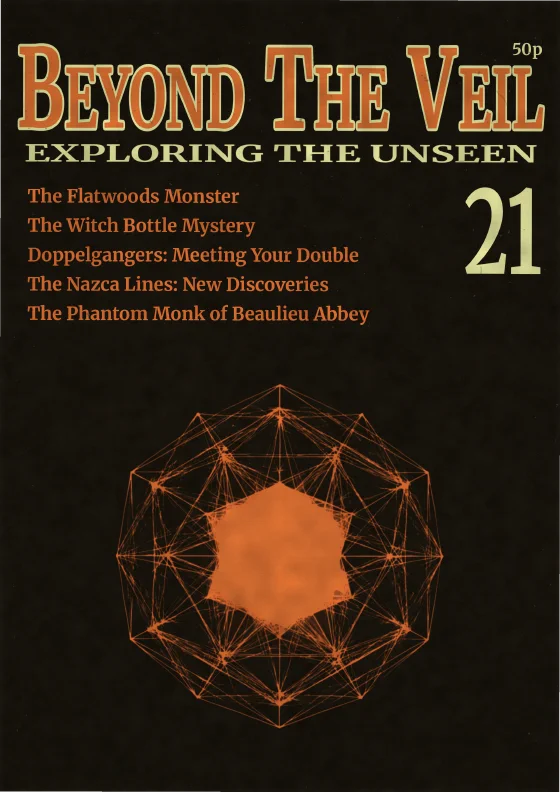
Doppelgangers: Meeting Your Double
Issue #21: September 1980
To meet one’s doppelgänger (one’s exact double) is, according to ancient belief, an omen of death. The word itself is German, meaning “double-walker,” and refers to a spectral replica of a living person. The phenomenon has been reported across cultures and centuries, from ancient Egypt to modern Europe.
Historical Cases
Percy Bysshe Shelley: The English poet reportedly saw his own double shortly before his death. On 23 June 1822, Shelley encountered a figure that appeared to be himself while walking along the terrace of his Italian villa. The apparition pointed silently toward the sea. Two weeks later, on 8 July, Shelley drowned when his boat sank in a storm off the Italian coast.
His wife, Mary Shelley, recorded the incident in her journal. She also noted that Shelley had dreamed of meeting his double, who asked him: “How long do you mean to be content?”
Abraham Lincoln: In November 1860, shortly after his election as President of the United States, Lincoln saw his reflection in a mirror produce two images: one clear, one faint and pallid. He interpreted this as a sign that he would be elected to a second term but would not live to complete it. His wife Mary believed the vision prophesied his death.
Lincoln was assassinated in April 1865, during his second term.
Queen Elizabeth I: According to contemporary accounts, the aging queen saw her own figure lying upon her bed shortly before her death in 1603. The apparition was pale and still, as though laid out for burial.
Goethe: The German poet Johann Wolfgang von Goethe described encountering his own double while riding along a road. The figure was dressed in a grey suit with gold trim, an outfit Goethe did not own. Eight years later, Goethe found himself riding the same road in exactly that suit.
The Nature of the Doppelgänger
What is a doppelgänger? Various traditions offer different explanations:
Spirit Double: Some cultures believe each person has a spirit double that can, under certain circumstances, become visible. This double may act independently, even appearing to others while the original person is elsewhere.
Astral Projection: Theosophical traditions suggest the doppelgänger is the astral body temporarily separated from the physical form. Crisis, illness, or impending death may weaken the connection between body and soul, allowing the astral form to wander.
Warning Entity: In Germanic folklore, the doppelgänger is a supernatural being that imitates the living, often appearing as an omen of death or misfortune. It may be malevolent, seeking to replace the original person.
Psychological Phenomenon: Modern psychiatry recognises autoscopy (the perception of one’s own body from an external viewpoint) as a neurological condition. It may result from disruption of the brain’s body-image processing.
The Vardøger Phenomenon
In Norwegian tradition, the vardøger is a spirit double that precedes a person, arriving at a destination before they do. Witnesses may hear footsteps, see a door open, or observe other signs of someone’s arrival, only to find no one there. The actual person appears minutes or hours later.
Unlike the doppelgänger, the vardøger is not considered an omen of death. It is simply the spirit going ahead, perhaps reconnoitring the path.
Similar phenomena are reported elsewhere. In Finland, the etiäinen serves the same function. In English tradition, fetches and wraiths occupy ambiguous territory between doppelgängers and ghosts.
Modern Encounters
Doppelgänger sightings continue in the modern era. Published accounts include cases such as:
Witnesses describing seeing a person standing at a window while that person was actually elsewhere in the house. The figure appeared for several seconds before fading.
Office workers reporting that they saw a colleague enter a building and walk to their desk, only for the actual person to arrive minutes later, having been delayed in transit.
Family members glimpsing relatives in locations where those relatives were not present, sometimes interpreting these visions as omens.
The Warning Function
If doppelgängers are real, what purpose do they serve? The association with death suggests they may be warnings, signals from some deeper level of consciousness that danger approaches.
Alternatively, they may be glitches in perception: moments when the brain’s mechanisms for distinguishing self from other temporarily fail. In this view, we are all capable of seeing our doubles; most of us simply never do.
Or perhaps the doppelgänger represents something more profound: evidence that our consciousness is not entirely bound to our physical bodies, that some part of us can walk ahead or behind, visible to others even when we are not present.
The phenomenon remains unexplained. But for those who have met their doubles, the experience is unforgettable, and often, deeply disturbing.
Readers who have encountered doppelgängers (their own or others’) are invited to write to our research department with detailed accounts.