

Editor's Note: This article has been faithfully transcribed from the original Beyond the Veil Magazine, Issue #20.
Archive Reference: BTV-020-02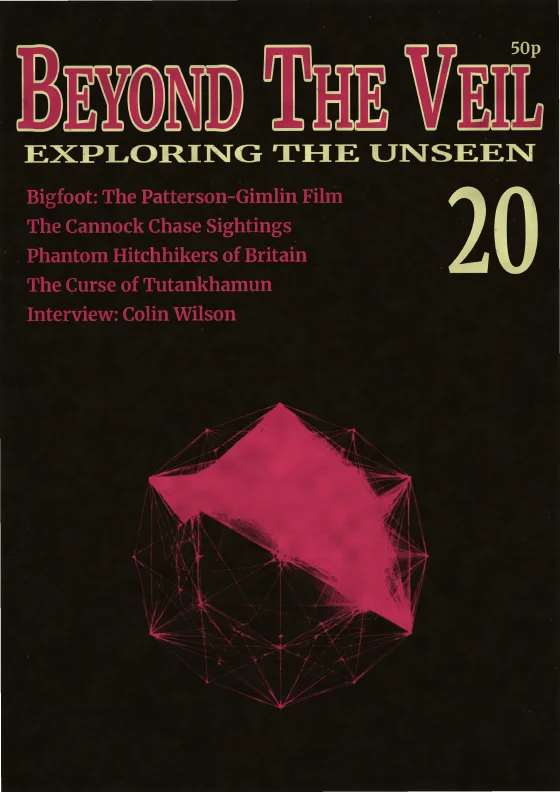
The Curse of Tutankhamun
Issue #20: August 1980
On 4 November 1922, a young Egyptian water boy stumbled upon a step carved into the bedrock of the Valley of the Kings. Within weeks, archaeologist Howard Carter and his patron Lord Carnarvon had uncovered the most spectacular tomb ever found in Egypt: the burial chamber of the boy-king Tutankhamun, dead for over three thousand years.
They had also, some believe, awakened a curse.
The Deaths Begin
Lord Carnarvon was the first to die. In April 1923, just five months after the tomb’s opening, he succumbed to blood poisoning following an infected mosquito bite. At the moment of his death, according to his son, all the lights in Cairo went out. In England, his dog reportedly howled and died at the same instant.
The press seized upon the story. Marie Corelli, a popular novelist, claimed that she possessed an ancient text warning of dire consequences for those who disturbed a pharaoh’s rest. Sir Arthur Conan Doyle, the creator of Sherlock Holmes and an ardent spiritualist, publicly endorsed the curse theory.
The deaths mounted:
George Jay Gould (1923): The American financier visited the tomb and died of fever shortly after.
Prince Ali Kamel Fahmy Bey (1923): An Egyptian prince who had visited the tomb was shot dead by his wife.
Aubrey Herbert (1923): Lord Carnarvon’s half-brother died of blood poisoning.
Sir Archibald Douglas Reid (1924): The radiologist who x-rayed the mummy died of mysterious illness.
Aaron Ember (1926): American Egyptologist died in a house fire.
Sir Lee Stack (1924): Governor-General of Sudan, assassinated in Cairo.
A. C. Mace (1928): Carter’s assistant, died of pleurisy after years of declining health.
By 1929, journalists counted at least 22 deaths that could be connected, however tenuously, to the tomb’s discovery.
The Sceptical View
Critics have challenged the curse theory on multiple grounds.
Lord Carnarvon was 57 years old and in poor health before he entered the tomb. He had suffered a serious car accident years earlier and his constitution was weakened. Death from an infected insect bite was not unusual in the Egypt of that era.
Many of the alleged “curse victims” had only tangential connections to the excavation. Some died years after their involvement. Others were shot or died in accidents that could hardly be attributed to supernatural intervention.
Howard Carter himself, who was present at every stage of the discovery and spent years cataloguing the tomb’s contents, lived until 1939, dying at age 64 of lymphoma, a perfectly natural cause. If the curse were real, surely its primary target would have been the man who first breached the burial chamber.
Statistical analysis suggests that the death rate among those connected with the tomb was no higher than would be expected for a similar group not involved in the excavation.
The Evidence for the Curse
Yet certain details remain troubling.
Carter’s pet canary was reportedly eaten by a cobra on the day the tomb was opened. The cobra was a symbol of royalty in ancient Egypt, associated with the protection of pharaohs.
Inscriptions found within the tomb warned that death would come “on swift wings” to those who disturbed the king’s rest. Whether these were genuine ancient curses or later inventions remains disputed.
Some researchers have proposed a more scientific explanation for the deaths: toxic mould. Sealed tombs may harbour fungal spores that, when inhaled by excavators, cause serious illness. This could explain the respiratory and fever deaths among those who entered the tomb. It does not, of course, explain the lights going out in Cairo or the dog dying in England.
The Continuing Pattern
The deaths did not end in the 1920s. As recently as the 1970s, individuals connected with Tutankhamun have died under circumstances some consider suspicious.
Mohammed Ibrahim (1966): The Director of Egyptian Antiquities, who agreed to the exhibition of Tutankhamun artefacts in France, was hit by a car and killed.
Dr. Gamal Mehrez (1972): Ibrahim’s successor, who oversaw the preparation of the artefacts for a London exhibition, died the night the crates were shipped.
Whether these deaths represent the curse’s continued operation or merely the ordinary mortality of those involved in Egyptology is impossible to say.
Conclusion
The Curse of Tutankhamun exists in a twilight realm between fact and legend. The deaths are real. The connections are documented. The pattern, to some observers, is unmistakable.
And yet the pattern may be no more than our tendency to find meaning in random events. Human beings seek causes. When people die, we want to know why. A curse provides an answer that is satisfying if not scientific.
Howard Carter dismissed the curse as nonsense, maintaining that pharaonic tombs were never guarded by spells. He spent his remaining years studying the tomb’s contents, apparently unmolested by supernatural forces.
Yet the legend persists. Each new death connected to the tomb is added to the tally. Each coincidence becomes evidence. And in the Valley of the Kings, where the dead have lain for millennia, the question remains: did the boy-king reach out from his sarcophagus to punish those who disturbed his eternal rest?
Readers with information about deaths or misfortunes connected to Egyptian archaeology are invited to contact our research department.