

Editor's Note: This article has been faithfully transcribed from the original Beyond the Veil Magazine, Issue #20.
Archive Reference: BTV-020-01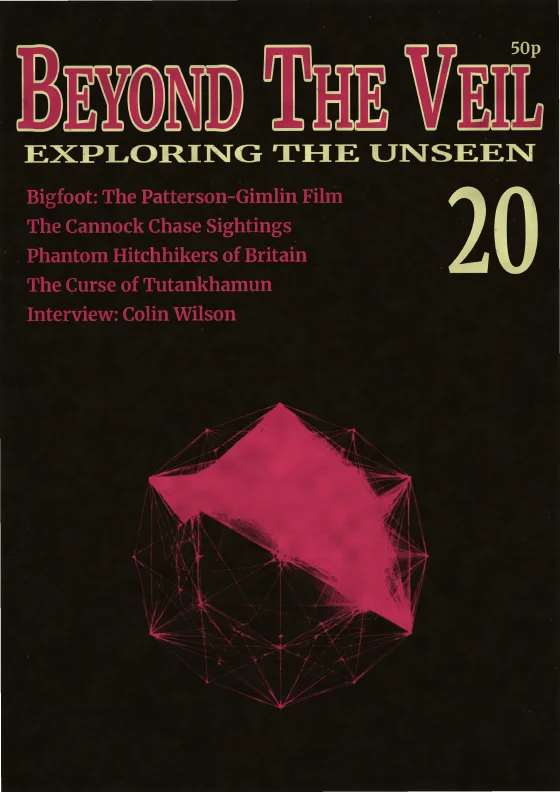
Bigfoot: The Patterson-Gimlin Film Analysis
Issue #20: August 1980
On 20 October 1967, Roger Patterson and Robert Gimlin captured 59.5 seconds of film footage at Bluff Creek, California. The footage shows a large, hair-covered humanoid walking away from the camera, turning to look back briefly before disappearing into the forest.
Thirteen years later, the Patterson-Gimlin film remains the most significant, and most contested, evidence for the existence of Bigfoot.
The Filming
Roger Patterson, a former rodeo rider turned Bigfoot enthusiast, had spent years searching for evidence of the creature. In October 1967, he and his friend Bob Gimlin ventured into the forests of Northern California on horseback, carrying a 16mm camera.
On the afternoon of 20 October, they rounded a bend in Bluff Creek and encountered the creature. Patterson’s horse reared, throwing him. He grabbed his camera and ran toward the figure, filming as he went.
The footage shows a creature walking away at a steady pace, turning once to look at the camera. It then disappears into the treeline. Patterson and Gimlin attempted to follow but lost the trail.
The next day, they returned with tracker Bob Titmus, who made casts of the footprints left at the site. The prints measured approximately 14.5 inches long and showed dermal ridges, the skin patterns that distinguish individual primates.
The Creature on Film
The subject of the film (often called “Patty” by researchers) displays characteristics that have been analysed for over a decade:
Size: Based on film analysis and the measured distances at the site, the creature is estimated to be between 6 feet 6 inches and 7 feet 4 inches tall, weighing between 500 and 700 pounds.
Gait: The creature walks with a distinctive stride, its arms swinging and its knees remaining bent throughout the gait cycle. This is unlike human walking, which involves locking the knees at full extension.
Muscle Movement: Frame-by-frame analysis shows apparent muscle movement beneath the surface, particularly in the thighs and shoulders. This suggests either a real creature or an extraordinarily sophisticated costume.
Breasts: The creature appears to be female, with visible mammary glands. This detail has been cited as evidence against a hoax: why would hoaxers complicate their costume with such features?
Proportions: The creature’s limbs are proportioned differently from a human’s. The arms are longer relative to the legs, and the torso is barrel-shaped.
The Analysis
Recent computer enhancement has allowed researchers to examine the footage in unprecedented detail.
Dr. Grover Krantz, a physical anthropologist at Washington State University, has concluded that the creature cannot be a human in a costume. The proportions are wrong, he argues. A human’s knees are at approximately half height; in the film subject, they appear to be much lower. No padding or costume could create this effect.
The compliant gait, with bent knees throughout the stride, is also significant. Humans naturally lock their knees when walking; maintaining a bent-knee stance requires considerable muscular effort and produces a distinctive movement pattern. The creature in the film displays this pattern naturally.
Film industry professionals have offered mixed opinions. Some costume experts argue that no suit technology available in 1967 could have produced the muscle movement visible in the film. Others maintain that a skilled costumer could have achieved the effect with a well-designed gorilla suit.
The Controversy
Sceptics have raised numerous objections:
Patterson’s Character: Roger Patterson was a promoter who had been seeking Bigfoot for years. He had a financial motive to produce evidence. He was known for exaggeration.
Convenient Filming: Critics note how fortunate it was that Patterson had his camera ready and captured steady footage of a creature that had eluded others for decades.
Hoax Claims: Over the years, rumours have circulated that the film was staged. Various individuals have claimed knowledge of a costume or involvement in a deception, but no one has produced the alleged suit or provided verifiable evidence of fabrication.
Technical Limitations: Some analysts argue that the 16mm footage is too degraded to support definitive conclusions either way.
The Current State
Roger Patterson died in 1972, maintaining until the end that his footage was genuine. Bob Gimlin remains alive and continues to assert that he witnessed a real creature.
The film has been subjected to every form of analysis available: frame-by-frame study, computer enhancement, biomechanical modelling, costume recreation attempts. No consensus has emerged.
If the film is genuine, it represents the best evidence ever obtained for an unknown North American primate. If it is a hoax, it is one of the most successful in history, surviving over a decade of scrutiny.
The truth, perhaps, lies somewhere in those 954 frames of footage, in the figure that walks through the California forest, turns to look at the camera, and disappears into the shadows.
Readers with expertise in film analysis, costume design, or primatology who may have insights into the Patterson-Gimlin film are invited to contact our research department.