

Editor's Note: This article has been faithfully transcribed from the original Beyond the Veil Magazine, Issue #18.
Archive Reference: BTV-018-01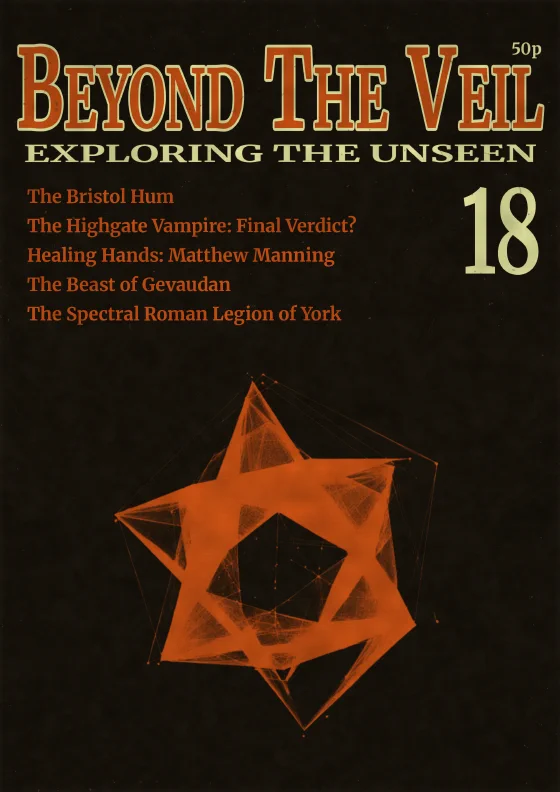
The Bristol Hum
Issue #18: June 1980
It begins after dark and continues through the night. A low, persistent drone that seems to come from everywhere and nowhere. It penetrates walls, fills rooms, and denies sleep to those who can hear it. Conventional instruments detect nothing.
Welcome to Bristol, where hundreds of residents are tormented by a sound that may not exist.
The Phenomenon
The Bristol Hum was first widely reported in 1979, when dozens of residents in the Avon area contacted local authorities complaining of a low-frequency noise that was disrupting their lives. The complaints shared common features:
The sound is most commonly heard at night, between midnight and 4 a.m. It is described as a low drone, similar to an idling diesel engine, a distant aircraft, or electrical machinery. It appears to pulse or throb. It is more noticeable indoors than outdoors.
Not everyone can hear it. In a typical household, one person may be severely affected while others hear nothing. The sound seems to affect women more than men, and middle-aged people more than the young.
Those who hear it describe considerable distress. Sleep becomes difficult or impossible. Concentration fails. Some report headaches, nausea, and irritability that persist even when the sound temporarily ceases.
The Investigation
Bristol City Council received so many complaints that it launched an official investigation. Environmental health officers toured the affected areas with sound-level meters and frequency analysers. They detected nothing unusual.
The council commissioned acoustic consultants. They too found nothing. Industrial facilities in the area were examined. No source was identified.
Professor Leventhall of Chelsea College, an expert in low-frequency noise, examined the phenomenon. He confirmed that the symptoms described by sufferers were consistent with exposure to infrasound (sound at frequencies below the threshold of normal hearing) but found no evidence of such sound in the environment.
Theories
Numerous explanations have been proposed:
Industrial Sources: Factories, power stations, or other facilities might produce low-frequency noise that travels considerable distances. However, no such source has been identified, and the hum persists when suspected facilities are shut down.
Traffic: The M32 motorway and other major roads might produce a cumulative drone. Yet the hum is reported in areas far from major roads and at times when traffic is minimal.
Gas Pipelines: High-pressure gas mains can produce vibrations. British Gas has examined its infrastructure and found no correlation with reported hum locations.
Electrical Infrastructure: Transformers and high-voltage lines produce electromagnetic fields that some people may perceive as sound. This theory remains unproven.
Atmospheric Phenomena: Temperature inversions and other atmospheric conditions can cause sounds to travel unusual distances. Perhaps the hum originates far from where it is heard.
Tinnitus: Some researchers suggest that sufferers are experiencing a form of tinnitus (ringing in the ears) that they project onto the environment. However, this fails to explain why multiple people in the same area report the same sound.
A Growing Phenomenon
Bristol is not unique. Similar hums have been reported in Largs, Scotland, and in communities across Europe and North America. The phenomenon appears to be spreading, with new locations added each year.
Some researchers suggest that the hum is a consequence of industrialisation, that our world has become so saturated with low-frequency noise that sensitive individuals can no longer escape it. Others propose that the hum is not acoustic at all, but electromagnetic, and that sufferers are perceiving fields that instruments are not designed to detect.
Living with the Hum
For those who hear it, the Bristol Hum is no abstract phenomenon. It is a nightly torment that degrades their quality of life and leaves them feeling disbelieved and dismissed.
As one sufferer described to local researchers: “People think you’re imagining it. But I know what I hear. It’s real. It’s driving me mad, and no one can tell me what it is or how to stop it.”
The council continues to receive complaints. Investigations continue to produce no answers. The hum continues to sound through Bristol nights, heard by some, undetectable by instruments, unexplained.
Conclusion
The Bristol Hum represents a peculiar category of phenomenon: something that clearly affects people’s lives but that cannot be objectively measured or definitively explained. Is it physical or psychological? Natural or artificial? The product of our industrial civilisation or something stranger still?
Until these questions are answered, the hum will continue. And its victims will continue to lie awake at night, listening to a sound that may exist only for them.
Readers who have experienced the Bristol Hum or similar phenomena elsewhere are invited to contact our research department with detailed accounts.