

Editor's Note: This article has been faithfully transcribed from the original Beyond the Veil Magazine, Issue #10.
Archive Reference: BTV-010-02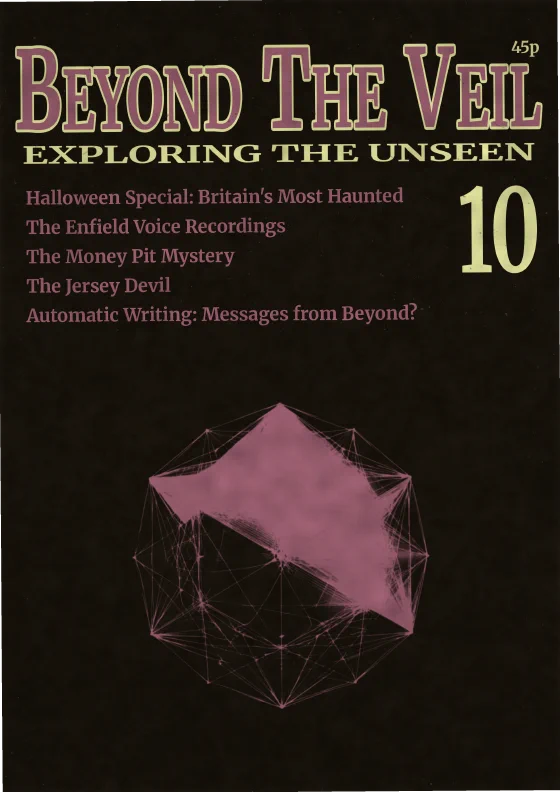
The Money Pit Mystery
Issue #10: October 1979
For nearly two hundred years, treasure hunters have been digging into Oak Island, a small landmass in Mahone Bay, Nova Scotia. Millions of pounds have been spent. At least six men have died. And still, no one has reached the bottom of the Money Pit.
The Discovery
In 1795, three teenagers (Daniel McGinnis, John Smith, and Anthony Vaughan) explored the uninhabited island and discovered a circular depression in a clearing. Above it, a ship’s tackle block hung from an oak branch. The boys began to dig.
At two feet, they found a layer of flagstones. At ten feet, a platform of oak logs. At twenty feet, another oak platform. At thirty feet, a third. The shaft had been carefully constructed by someone with considerable engineering skill.
The boys lacked the resources to continue. They returned with a commercial expedition in 1803. This team dug to ninety feet, finding log platforms every ten feet, along with layers of charcoal, putty, and coconut fibre (the last of which does not grow within 1,500 miles of Nova Scotia).
At ninety-three feet, they discovered a stone inscribed with strange symbols. A later translation claimed it read: “Forty feet below, two million pounds are buried.”
That night, the shaft flooded to the sixty-foot level. No amount of bailing could remove the water. Whoever had built the pit had also engineered a booby trap: flood tunnels connected to the nearby beach, ensuring that any excavation below a certain depth would be inundated by the sea.
Centuries of Failure
Over the following two centuries, expedition after expedition attempted to reach the treasure. All failed.
In 1849, a drilling team brought up links of gold chain and parchment with writing on it. The next year, the drilling struck what felt like loose metal at 98 feet and 104 feet before hitting clay, possibly containers of coins. They could bring nothing to the surface.
In 1861, the bottom of the original pit collapsed into a deeper chamber. The treasure, if treasure it was, had fallen beyond reach.
In 1897, drilling recovered a fragment of sheepskin parchment inscribed with letters in India ink. The text was never deciphered.
Efforts continued throughout the twentieth century. The beach was excavated, revealing stone drains that fed seawater into the flood tunnels. The pit was explored with closed-circuit television, revealing apparent chests at depth. Yet the treasure remains unretrieved.
What Lies Below?
Theories about the pit’s contents range from the plausible to the fantastic:
Pirate Treasure: Captain Kidd operated in the area in the 1690s, and local legend long associated him with Oak Island. But Kidd was a relatively minor pirate; could he have commanded the resources to build such an elaborate vault?
The French Crown Jewels: Some believe the treasure is the fortune of Louis XVI and Marie Antoinette, smuggled from France during the Revolution and hidden by fleeing nobles.
Shakespeare’s Manuscripts: Adherents of the Baconian theory (that Francis Bacon wrote Shakespeare’s plays) suggest that the original manuscripts are buried in the pit, along with proof of authorship.
The Holy Grail: Some connect Oak Island to the Knights Templar, suggesting that the pit contains relics from the Crusades, possibly including the Ark of the Covenant or the Holy Grail itself.
Nothing at All: Sceptics propose that the pit is a natural sinkhole, modified by early treasure hunters who misinterpreted its features. The “flood tunnels” are natural channels; the “platforms” are compressed vegetation. There is no treasure.
The Curse
Legend holds that the Money Pit will claim seven lives before revealing its treasure. Six have died so far: one in 1861 when a boiler exploded, four in 1965 when they were overcome by fumes in a flooded shaft, and one in 1897 when a rope snapped.
Whether the curse is real or merely dark coincidence, the pit continues to demand sacrifice from those who seek its secrets.
Current Exploration
The most recent expedition, led by Dan Blankenship and David Tobias, has brought modern technology to bear on the island. Drilling, diving, and sonar mapping have produced tantalising hints: apparent chambers, metal objects, and cavities deep beneath the surface.
A television camera lowered into a borehole in 1971 appeared to show a human hand floating in murky water. Subsequent dives found nothing at that location.
The expedition continues, though results remain frustratingly elusive. Each discovery raises more questions than it answers. Each attempt to reach the treasure is thwarted by flooding, collapse, or equipment failure.
The Enduring Question
What lies at the bottom of the Money Pit?
After two centuries and countless millions spent in pursuit, no one knows. The pit has consumed fortunes and lives, given up tantalising fragments (gold links, parchment, mysterious inscriptions) but never its central secret.
Perhaps the treasure is beyond reach, collapsed into some deeper cavity or scattered by centuries of drilling. Perhaps it was retrieved long ago by parties unknown, leaving only an empty shaft. Perhaps there never was a treasure, only an elaborate construction whose purpose we do not understand.
The Money Pit keeps its secrets. It has done so for two hundred years. It may do so forever.
Readers with expertise in engineering, cryptography, or treasure hunting who may have insights into the Money Pit mystery are invited to contact our research department.