

Editor's Note: This article has been faithfully transcribed from the original Beyond the Veil Magazine, Issue #10.
Archive Reference: BTV-010-01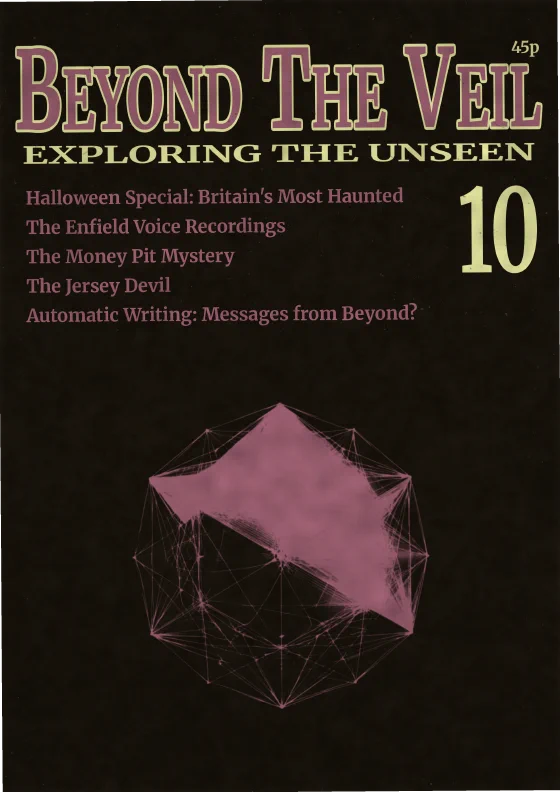
Halloween Special: Britain's Most Haunted Locations
Issue #10: October 1979
As October draws to its dark conclusion and the veil between worlds grows thin, we present our comprehensive guide to Britain’s most haunted locations. These sites have accumulated centuries of supernatural reports, witnessed by countless observers, documented by serious researchers.
Edinburgh Castle, Scotland
Perched atop Castle Rock, Edinburgh Castle has witnessed over a thousand years of human conflict, imprisonment, and death. Small wonder that it is considered the most haunted building in Scotland.
The most frequently reported apparition is that of a headless drummer boy, first seen in 1650 before Cromwell’s forces attacked the castle. He appears before momentous events, his drumming audible through stone walls several feet thick.
The castle’s dungeons, where prisoners were held in conditions of unspeakable squalor, produce regular reports of unexplained phenomena. Visitors describe sudden drops in temperature, the sensation of being watched, and the sound of footsteps in empty corridors. Paranormal researchers who have investigated the castle report that even those unaware of its history experience unease in specific locations.
The ghost of Lady Glamis, burned as a witch in 1537 on accusations of plotting to poison King James V, has been seen on the castle esplanade, surrounded by flames that give no heat.
Pluckley, Kent
This quiet village in the Garden of England holds the unofficial record for the most ghosts per square mile in Britain. At least twelve distinct spectres have been documented, each with their own history and territory.
The Screaming Man haunts the brickworks on the edge of the village, where a worker fell to his death in clay pits during the nineteenth century. His screams are heard on winter nights when conditions match those of his fatal accident.
The Red Lady walks the churchyard of St. Nicholas, said to be the ghost of a woman of the Dering family, buried in the 1100s in seven lead coffins, one inside the other. She searches for something she lost in life.
The Highwayman stalks Fright Corner, where he was pinned to an oak tree by a sword during a confrontation with villagers. The tree still stands, and witnesses report seeing a figure in period dress at twilight.
Other phantoms include a schoolmaster who hanged himself, a gypsy woman who burned to death smoking her pipe, a miller, and the sound of ghostly coaches on roads that were rerouted centuries ago.
Borley Rectory, Essex
Though the rectory itself burned in 1939 and was demolished in 1944, the site remains one of Britain’s most investigated paranormal locations. For a full account, see our feature article in Issue #1.
The spectral nun still walks the grounds. Investigators report cold spots, the sound of footsteps, and the sensation of an unseen presence. Whatever haunted the rectory appears to have survived its destruction.
The Tower of London
For nearly a thousand years, the Tower has served as fortress, palace, prison, and place of execution. The spirits of those who died within its walls are said to walk still.
Anne Boleyn, second wife of Henry VIII and mother of Elizabeth I, was beheaded on Tower Green in 1536. Her ghost, sometimes headless, has been seen near the Chapel of St. Peter ad Vincula where her body lies buried. In 1864, a sentry challenged a white figure approaching his post. When it did not respond, he thrust his bayonet through it. The blade passed through empty air.
The Princes in the Tower (Edward V and Richard, Duke of York) were imprisoned here in 1483 and never seen alive again. Workmen in 1674 discovered a box containing the bones of two children beneath a staircase; whether these were the princes remains disputed. Small figures in white have been reported in the Bloody Tower, standing hand in hand, watching in silence.
The most terrifying sighting occurred in 1816, when a guard saw a great bear emerge from beneath a door. He lunged at it with his bayonet, but the weapon passed through the animal. The guard died of shock within days.
The Ancient Ram Inn, Gloucestershire
Built in 1145, this former inn in Wotton-under-Edge may be England’s most haunted private residence. Its owner, John Humphries, has documented over 20 distinct entities during his decades of residence.
The inn was built on the site of a pagan burial ground and an ancient ley line intersection. During renovations, Humphries discovered the skeletons of children beneath the floors, along with broken daggers suggesting sacrifice. A high priestess of a witch cult is said to have been buried beneath the bar.
The phenomena are aggressive. Visitors report being pushed, scratched, and held down on beds. A malevolent incubus allegedly attacks women in the Bishop’s Room. Objects move. Doors open and close. The temperature drops to freezing in specific locations.
Glamis Castle, Angus
The childhood home of the late Queen Elizabeth the Queen Mother harbours secrets that the royal family has never disclosed. A hidden room, bricked up generations ago, is said to contain something that no outsider may see.
The Monster of Glamis, according to legend, was a hideously deformed heir to the earldom, born in the early nineteenth century. Rather than acknowledge him, the family imprisoned him in a secret chamber, where he lived for decades, unknown to all but the Earl and his factor. The room’s location is said to have been known to every Earl, and to have driven several to drink.
The ghost of the “Grey Lady” appears in the chapel. The Earl Beardie, a notorious gambler said to have played cards with the Devil, is heard rolling dice in a tower room. A servant girl who witnessed something terrible was walled up alive; her ghost runs screaming through the corridors.
Chambercombe Manor, Devon
This eleventh-century manor house conceals a crime that was not discovered for two centuries. In the 1860s, workmen found a hidden room containing a skeleton on a bed, still dressed in fine clothes and jewellery.
The woman had been walled up alive, apparently by her own father, after he robbed and murdered her without recognising her. When he later learned what he had done, he sealed the room rather than reveal his crime.
The ghost, known as the Lady in Grey, walks the corridors and stands by windows, looking out as though waiting for a rescue that will never come.
A Note of Caution
These locations, and others like them, attract many visitors seeking supernatural experiences. We advise caution. Not all haunted sites welcome investigation, and not all spirits are benign.
Those who seek the unknown should do so with respect: for the dead, for the living, and for forces that may not care to be disturbed.
Readers who have had experiences at any of these locations, or who know of other haunted sites deserving investigation, are invited to write to our research department.