

Editor's Note: This article has been faithfully transcribed from the original Beyond the Veil Magazine, Issue #9.
Archive Reference: BTV-009-02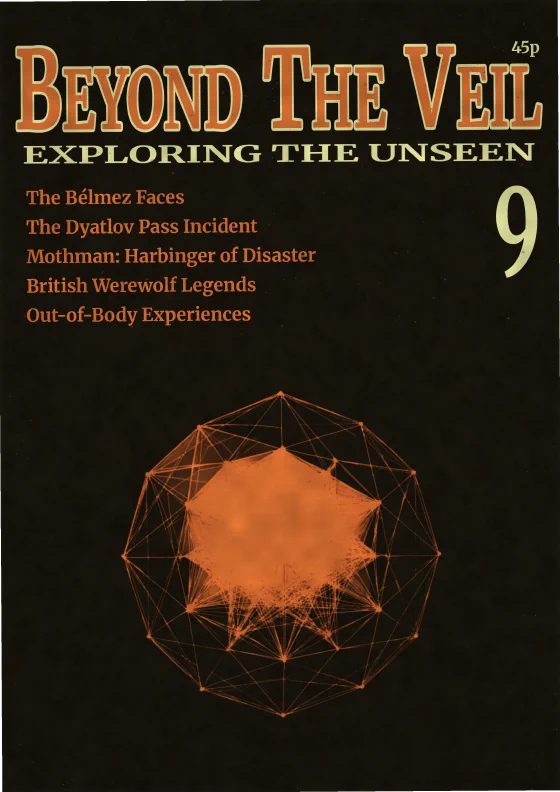
The Dyatlov Pass Incident
Issue #9: September 1979
In February 1959, nine experienced hikers died on the slopes of Kholat Syakhl (a mountain whose name, in the language of the indigenous Mansi people, translates as “Dead Mountain”). What killed them has never been satisfactorily explained.
The Dyatlov Pass Incident, named after the group’s leader, Igor Dyatlov, remains one of the most disturbing mysteries of the twentieth century.
The Expedition
The group consisted of eight men and two women, all students or graduates of the Ural Polytechnic Institute in Sverdlovsk. They were experienced hikers and skiers, undertaking a challenging winter expedition to Mount Otorten in the northern Urals. The route was classified as Category III, the most difficult.
They departed on 27 January 1959. One member, Yuri Yudin, turned back due to illness, a decision that saved his life. The remaining nine continued into the mountains.
The last entry in the group’s diary is dated 1 February, describing their progress through heavy snow. That night, something happened. What, exactly, remains unknown.
The Discovery
When the group failed to return by their expected date, search parties were dispatched. On 26 February, searchers discovered the tent on the slopes of Kholat Syakhl. It had been ripped open from the inside.
The hikers had fled into the night wearing minimal clothing: some were barefoot, others wore only socks. Temperatures that night dropped to approximately minus 30 degrees Celsius.
The first two bodies were found near the remains of a small fire, under a cedar tree at the edge of the forest, 1.5 kilometres from the tent. They were dressed only in underwear. Branches of the cedar had been broken up to five metres high, as though someone had climbed the tree, but for what purpose?
Three more bodies were found between the cedar and the tent, positioned as though they had been trying to return. They were better dressed, perhaps having taken clothing from the dead.
The remaining four bodies were not found until May, buried under several metres of snow in a ravine 75 metres from the cedar. Their injuries were catastrophic.
The Injuries
The first five victims had died of hypothermia. This was terrible but explicable: inadequately dressed, they had frozen in the Ural winter.
The final four had suffered injuries that hypothermia could not explain.
Lyudmila Dubinina had major chest fractures and was missing her tongue, eyes, part of her lips, and a fragment of her skull. Semyon Zolotaryov had similar chest fractures. Alexander Kolevatov had a deformed neck. Nicolas Thibeaux-Brignollel’s skull was crushed.
The force required to cause such injuries was compared by medical examiners to that of a car crash. Yet there were no external wounds: the damage was entirely internal. Something had crushed them with tremendous force without breaking the skin.
And some of their clothing tested positive for radioactive contamination.
The Official Investigation
Soviet authorities conducted an investigation that was closed in May 1959. The official conclusion was that the group had died from a “compelling natural force” they were unable to overcome. The case files were classified and the area declared off-limits for three years.
This explanation satisfied no one.
Theories
Numerous theories have been proposed to explain the Dyatlov tragedy:
Avalanche: The group heard or saw signs of an impending avalanche and fled the tent in panic. Yet no avalanche debris was found, and experienced hikers would have moved laterally rather than downhill.
Katabatic Wind: A sudden, violent downdraft could have collapsed the tent and disoriented the hikers. This might explain their flight but not the crushing injuries.
Military Testing: The Soviet Union conducted weapons tests in the region. Some researchers believe the group inadvertently witnessed something they were not meant to see, or were caught in the effects of an experimental weapon. The radioactive contamination supports this theory.
Indigenous Attack: The Mansi people considered the mountain sacred and might have objected to the expedition. However, there is no evidence of any confrontation, and the Mansi cooperated fully with the investigation.
Infrasound: Some researchers have proposed that unusual wind conditions produced infrasound (low-frequency sound waves that can cause disorientation, panic, and even physiological damage). This might explain the irrational behaviour but not the crushing injuries.
Unknown Entity: Some have suggested that the group encountered something they could not understand, whether animal, human, or otherwise. Several witnesses reported seeing strange orange spheres in the sky over the Urals in February 1959, which remains unexplained.
The Enduring Mystery
Twenty years later, the Dyatlov Pass Incident remains unsolved. The official files, though now partially declassified, contain gaps and inconsistencies that suggest information was deliberately withheld.
Whatever happened on Kholat Syakhl that night killed nine young people in circumstances that defy rational explanation. They fled their shelter in temperatures that meant certain death. Some climbed trees. Others suffered injuries that should have required massive force to inflict. Their clothing was radioactive.
The mountain keeps its secrets. The dead have not spoken.
The Dyatlov Pass Incident represents one of the most thoroughly documented unsolved mysteries of the modern era. Readers with information regarding Soviet-era incidents in the Ural region are invited to contact our research department.