

Editor's Note: This article has been faithfully transcribed from the original Beyond the Veil Magazine, Issue #9.
Archive Reference: BTV-009-01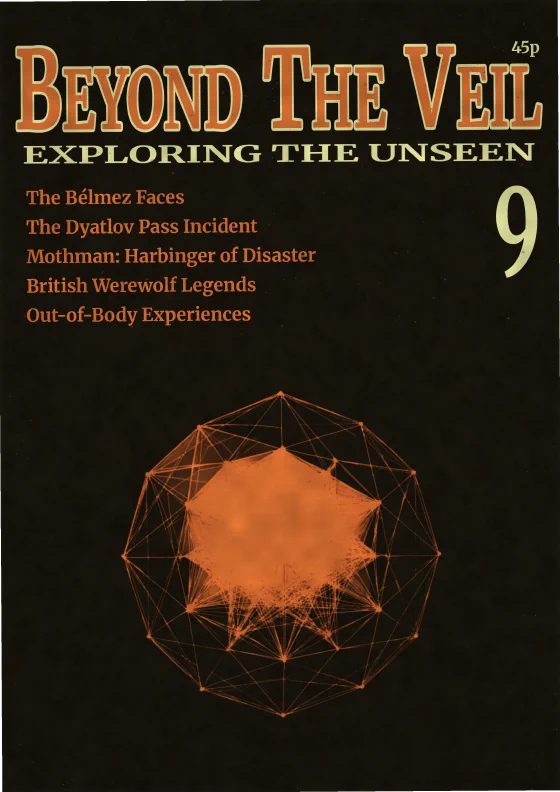
The Bélmez Faces
Issue #9: September 1979
In August 1971, María Gómez Cámara noticed a stain on the concrete floor of her kitchen in Bélmez de la Moraleda, a small village in Andalusia, Spain. Over the following days, the stain took form. It became a face, melancholy, with dark eyes and an expression of profound sadness.
María’s son, Miguel, attacked the face with a pickaxe. He laid new concrete over the floor. Within days, the face returned. And it was not alone.
The Phenomenon
The Bélmez Faces, as they have come to be known, continue to appear eight years later. They emerge gradually from the concrete, like photographs developing in a darkroom. Some are male, some female, some barely recognisable as human. They shift position over time, their expressions changing, their features evolving.
Attempts to destroy them have failed. The floor has been replaced multiple times. The faces return, appearing in new locations, with new configurations. Some investigators have photographed dozens of distinct faces; others claim to have counted over a hundred.
The house on Calle Real 5 has become Spain’s most famous haunted location, attracting thousands of visitors and researchers from across Europe.
Investigation and Controversy
The case attracted immediate attention from parapsychologists. Dr. Germán de Argumosa, a prominent Spanish researcher, conducted extensive investigations. He sealed the kitchen, installed cameras, and documented the faces’ gradual emergence over periods of hours and days.
Argumosa’s team made a startling discovery: beneath the kitchen floor lay the remains of a medieval cemetery. Human bones were excavated, skulls that bore unsettling resemblances to some of the faces on the floor. The bones were removed and reburied in consecrated ground, but the faces continued to appear.
Electronic voice phenomena (EVP) recordings made in the kitchen captured what Argumosa interpreted as voices: whispers, sighs, and fragmentary words in archaic Spanish. Some researchers claimed to hear prayers; others, laments.
Thermography revealed temperature differentials around the faces, though this could be explained by variations in the concrete’s composition. Chemical analysis of the stains found no evidence of paint or artificial colouring; the faces appeared to be integral to the concrete itself.
Sceptical Challenges
Not all investigators have been convinced. Some have suggested that María Gómez Cámara, or perhaps her son, created the faces deliberately, using acidic substances or other techniques to produce the images. The family has profited modestly from the tourism the faces attract, which critics cite as a possible motive.
Chemical analysis has been inconclusive. Some tests found no evidence of paint or artificial colouring; others suggested possible traces of ash or burned material. Without controlled laboratory conditions, definitive conclusions remain elusive.
The controversy continues. Believers point to the sheer number of faces, their evolution over time, and the difficulty of creating such images in concrete without leaving detectable traces. Sceptics note that no controlled scientific study has been permitted, and that the phenomena have never been observed emerging in real time by trained investigators.
The Current Situation
María Gómez Cámara, now in her sixties, continues to live in the house on Calle Real 5. She has grown accustomed to the faces, even protective of them.
“They are my family now,” she told a visiting researcher recently. “They were here before me, and they will be here after.”
Her son, Miguel, assists with the modest tourism the phenomenon attracts. New faces continue to emerge, though perhaps less frequently than in the early 1970s. The original face, the first melancholy image that appeared in 1971, remains visible in the kitchen, its expression unchanged after eight years.
Meaning and Significance
Whatever their origin, the Bélmez Faces represent one of the most persistent and puzzling phenomena in modern paranormal research. If genuine, they suggest a mechanism by which the dead might communicate with the living, or by which psychic energy might manifest in physical form.
If fraudulent, they represent an extraordinarily elaborate and long-sustained deception, maintained over decades by an elderly peasant woman with no obvious means or motivation.
The faces stare up from the floor of a kitchen in a small Spanish village, and they offer no answers. They merely watch, and wait, as they have done for nearly a decade.
Readers who have witnessed similar phenomena, images appearing spontaneously on surfaces, are encouraged to contact our research department.