

Editor's Note: This article has been faithfully transcribed from the original Beyond the Veil Magazine, Issue #2.
Archive Reference: BTV-002-02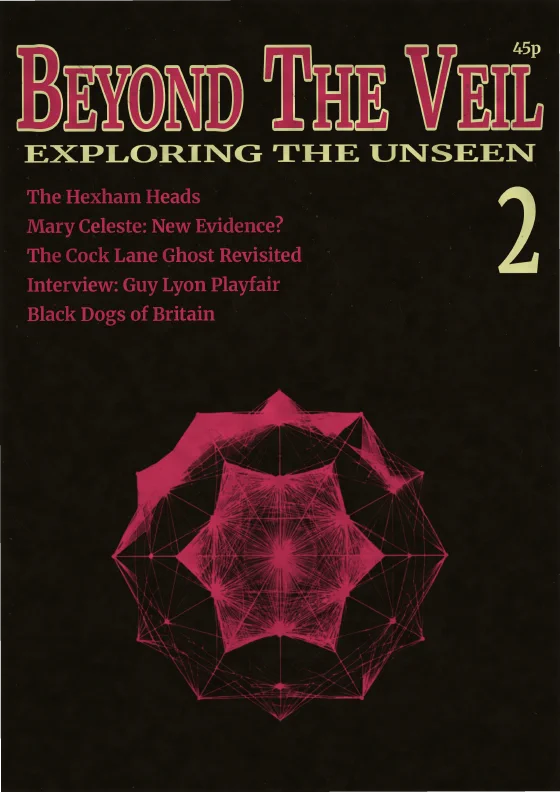
Black Dogs of Britain
Issue #2: February 1979
They go by many names: Black Shuck in East Anglia, Padfoot in the Midlands, Barghest in Yorkshire, Gytrash in the North. They are reported on lonely roads and ancient trackways, near churchyards and crossroads, along ley lines and boundaries. They are the phantom black dogs of Britain, and their appearance has terrified travellers for over a thousand years.
The East Anglian Shuck
The most famous British phantom hound is Black Shuck, whose name derives from the Old English scucca, meaning demon. His territory encompasses Norfolk, Suffolk, Essex, and Cambridgeshire, where he has been sighted for centuries.
The earliest documented account dates to 4 August 1577, when a black dog burst into the church at Bungay, Suffolk, during a violent thunderstorm. According to Abraham Fleming’s contemporary pamphlet, the creature killed two worshippers and left a third “shrunken up, as it were drawn together, like a piece of leather scorched in a hot fire.”
The dog then appeared at Blythburgh Church, seven miles distant, killing another three parishioners. Scorch marks on the church door, visible to this day, are attributed to Shuck’s passing.
Modern sightings continue. In 1972, a motorist on the A12 near Blythburgh reported that a large black dog ran alongside his car for several hundred yards before vanishing. In 1976, a couple walking near Dunwich described a dog “the size of a calf” with glowing red eyes that watched them from a hedgerow before dissolving into mist.
The Yorkshire Barghest
Yorkshire’s phantom hound is the Barghest, a creature said to presage death. Unlike Shuck, whose appearance may be neutral or even protective, the Barghest is universally regarded as an omen of doom.
The Barghest is most often seen in the Trough of Bowland and on the ancient roads around York. Those who encounter it rarely survive the year, according to local tradition. The creature is described as larger than any natural dog, with eyes like burning coals and a howl that freezes the blood.
In 1893, a farm labourer named Thomas Waddington encountered the Barghest on a road near Grassington. He described it as “a black thing the size of a donkey, with eyes like lanterns.” Waddington died three weeks later, reportedly of fright.
The Wisht Hounds of Dartmoor
Dartmoor hosts perhaps the most terrifying variation of the black dog legend: the Wisht Hounds, spectral dogs said to hunt the souls of the unbaptised across the moor. They are led by a huntsman variously identified as the Devil, Dewer (an ancient deity), or Sir Francis Drake.
The hounds are heard rather than seen, their baying carrying across the moorland on wild nights. Those who hear them are advised to throw themselves face-down in the heather and pray, for to look upon the Wild Hunt means death or madness.
In 1677, a Devon man named Bowerman claimed to have seen the hunt pass over Hound Tor. He was found dead the next morning, his face frozen in an expression of absolute terror. No cause of death was ever determined.
Regional Variations
Nearly every county in Britain has its own phantom hound tradition:
Lancashire: The Skriker, a shape-shifting dog whose footsteps sound like chains dragging.
Somerset: The Gurt Dog, a protective spirit that guides lost travellers to safety.
Wales: The Gwyllgi, the Dog of Darkness, seen on roads around Carmarthen.
Scotland: The Cù Sìth, a green-furred fairy hound whose bark is heard three times before death.
Lincolnshire: Hairy Jack, a benevolent black dog that protects lone women travelling at night.
Explanations and Interpretations
Folklorists have proposed various origins for the black dog tradition. Some see them as folk memories of wolf packs, extinct in Britain since the eighteenth century. Others suggest they represent pre-Christian deities demonised by the Church, or psychopomps (guides for the souls of the dead) from an earlier religious tradition.
The association with roads and boundaries is significant. In Celtic belief, boundaries were liminal spaces where the ordinary world met the supernatural. Crossroads, especially, were places of power where spirits might be encountered.
The connection to death and churchyards suggests a possible origin in gravedigger’s dogs, which might have been seen lurking near burial sites. Yet this fails to explain the supernatural attributes consistently reported: the glowing eyes, the impossible size, the ability to vanish instantaneously.
Modern Encounters
Whatever their origin, black dog sightings continue into the present day. The Society for Psychical Research has collected over three hundred reports from the twentieth century alone. Witnesses consistently describe creatures of unusual size, often with luminous eyes, that display no fear of humans and frequently vanish without trace.
In 1945, a group of American servicemen driving through Norfolk encountered a black dog that ran through the beam of their headlights and continued through the closed door of a barn without slowing. In 1968, a postman on his rounds near Beccles was accompanied for half a mile by a black dog that left no pawprints in fresh snow.
These modern accounts differ little from medieval ones, suggesting that whatever phenomenon underlies the black dog tradition, it remains active in contemporary Britain.
A Warning to Travellers
Whether protective spirits or omens of death, the black dogs of Britain demand respect. Those who encounter them are advised to neither run nor challenge the apparition. Speaking to a black dog is generally considered unwise; meeting its gaze, dangerous.
Local folklore advises caution: “If you see old Shuck, you touch your cap and you walk on. Don’t look back. Don’t speak. Just walk on and mind your business. He’ll mind his.”
This survey represents only a fraction of British black dog traditions. Readers with personal accounts of phantom hound encounters are encouraged to write to our research department.