

Editor's Note: This article has been faithfully transcribed from the original Beyond the Veil Magazine, Issue #1.
Archive Reference: BTV-001-02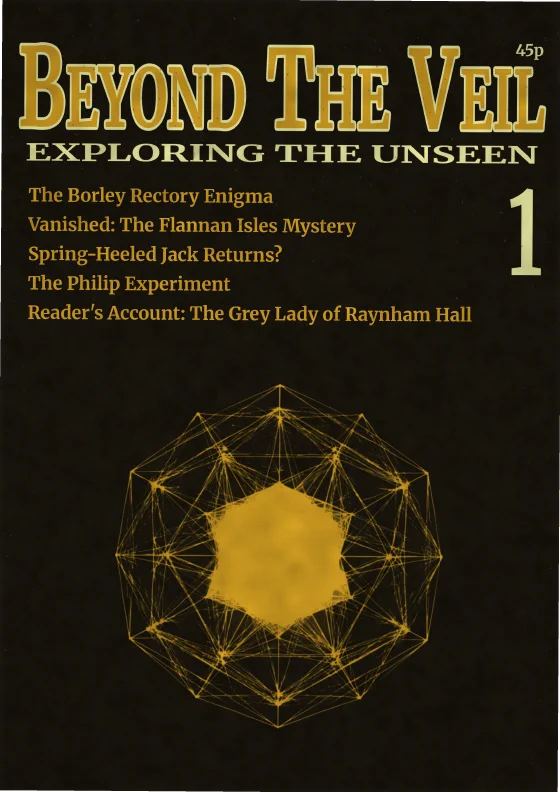
Vanished: The Flannan Isles Mystery
Issue #1: January 1979
On Boxing Day 1900, the relief vessel Hesperus approached the Flannan Isles, a remote cluster of rocky outcrops twenty miles west of the Outer Hebrides. Captain James Harvey expected the routine handover of lighthouse duties. Instead, he discovered one of the most baffling disappearances in maritime history.
The lighthouse on Eilean Mòr stood dark. No flag flew from the mast. No keepers appeared to greet the vessel.
The Discovery
Joseph Moore, the relief keeper, was rowed ashore through rough surf. What he found chilled him more than the December wind. The entrance gate and outer door stood closed. The inner door was unlocked. The clock had stopped. The fire was cold, the beds unmade, and the last entry in the log was dated 15 December, eleven days earlier.
Of Thomas Marshall, James Ducat, and Donald MacArthur, there was no sign.
Moore searched the entire island. The west landing, exposed to the full fury of Atlantic storms, showed signs of tremendous damage. An iron railing had been bent, a concrete block weighing over a ton had been displaced, and turf had been torn from the cliff top forty feet above sea level.
Yet it had not been storming on 15 December. Weather records from neighbouring islands confirmed moderate conditions.
The Final Log Entries
The lighthouse log, maintained meticulously by Principal Keeper Ducat, contained entries that would puzzle investigators for decades. The final days recorded:
12 December: Severe winds, the likes of which I have never seen. Marshall is very quiet. Ducat irritable.
13 December: Storm continued through night. MacArthur crying.
14 December: Noon, grey daylight. Me, Marshall and the Principal praying.
15 December: Storm ended. Sea calm. God is over all.
These entries defied explanation. No storm of unusual severity had been recorded anywhere in the region during those dates. Why would experienced keepers, hardened to island life, be reduced to tears and prayer by weather conditions that apparently existed only in their logs?
Theories and Speculation
The official inquiry, conducted by Robert Muirhead of the Northern Lighthouse Board, concluded that the three men had gone to secure equipment at the west landing and been swept away by an unexpected wave. The oilskins and sea boots of Marshall and Ducat were missing; MacArthur’s were found, suggesting he had rushed out without proper attire.
Yet this explanation satisfied few. The keepers knew the dangers of the west landing better than anyone. They would never have left the lighthouse unmanned, as regulations strictly forbade all three keepers being outside simultaneously. And why had MacArthur, the youngest and strongest, gone out without his weatherproof clothing in December?
Alternative theories emerged over the following decades. Some suggested that one keeper had gone mad and killed the others before throwing himself into the sea. Others proposed that a foreign vessel had abducted them, or that they had fled to start new lives elsewhere. None accounted for all the evidence.
The Paranormal Dimension
Local tradition held that the Flannan Isles were home to the Fir Mhor, the Big Men, spirits who resented human intrusion. Shepherds who had grazed sheep on the islands spoke of an oppressive presence, of being watched by unseen eyes.
In 1912, the poet Wilfrid Wilson Gibson published “Flannan Isle,” a dramatic rendering of the mystery that emphasised its supernatural overtones. Though fiction, it captured something of the unease that still surrounded the case:
We seemed to stand for an endless while, Though still no word was said, Three men alive on Flannan Isle, Who thought on three men dead.
Subsequent keepers reported disturbing experiences. In 1905, a relief keeper claimed to have heard voices calling to him from the rocks below, speaking in an archaic Gaelic dialect. Another, in 1911, insisted he had seen three figures standing on the west landing at dusk, only for them to vanish when he approached.
The lighthouse was automated in 1971, ending permanent human occupation of Eilean Mòr. The mystery remains precisely what it was on that December day in 1900: three men who walked out of a lighthouse and into oblivion.
The Questions That Remain
Nearly eighty years later, the Flannan Isles case continues to resist resolution. The strange log entries, the damaged landing, the missing men, and the lingering atmosphere of the islands themselves combine to create a mystery that transcends simple explanation.
Were Thomas Marshall, James Ducat, and Donald MacArthur victims of a freak wave? Did they succumb to some form of shared madness? Or did something else entirely claim them on that remote Atlantic rock?
The lighthouse still stands, its automated light sweeping the empty waters. But the question posed by those final log entries remains unanswered: what had those three men been praying for, and did their prayers go unheard?
The Flannan Isles case remains open. Any readers with information regarding similar maritime disappearances or anomalous lighthouse phenomena are invited to contact our research department.