
Editor's Note: This article has been faithfully transcribed from the original Beyond the Veil Magazine, Issue #1.
Archive Reference: BTV-001-01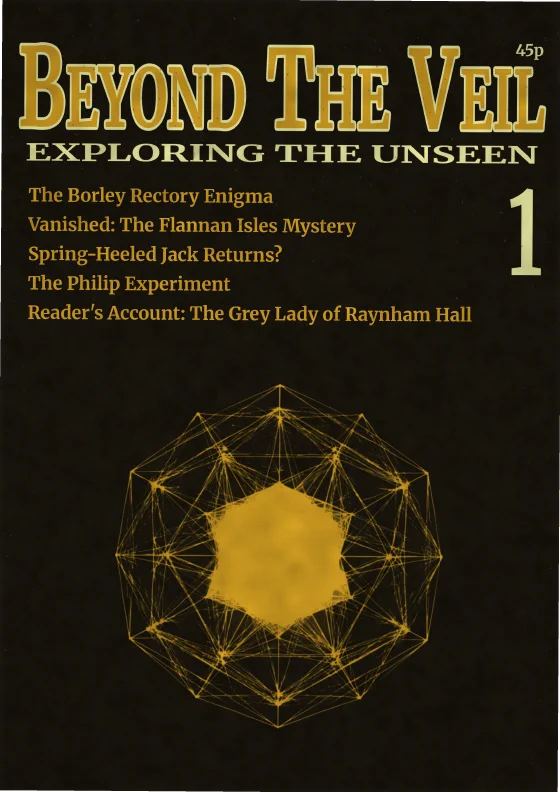
The Borley Rectory Enigma
Issue #1: January 1979
With this first issue of Beyond the Veil, we undertake to document the unexplained with rigour and objectivity. We begin with the case that has defined British paranormal investigation for half a century: Borley Rectory, the so-called “most haunted house in England.”
The rectory burned forty years ago. The site today is little more than rubble and vegetation, difficult to locate without local guidance. But what occurred there between 1862 and 1939 remains the most extensively documented haunting in British history, and among the most controversial.
The Weight of Testimony
The Reverend Henry Bull built Borley Rectory in 1862. By 1863, servants were already refusing to sleep in certain rooms. The phenomena, whatever they were, predated Harry Price’s famous investigation by six decades. They predated the Foyster tenancy with its violent escalations. They predated the birth of most of their critics.
The Bull family occupied the rectory for nearly sixty years, and their accounts form the foundation of the haunting’s history. Multiple family members reported seeing a spectral nun gliding along what came to be known as the “Nun’s Walk,” a path beside the rectory garden. Servants heard footsteps in empty corridors. Bells rang without human agency.
Harry Bull, who succeeded his father as rector, built a summer house specifically positioned to observe the Nun’s Walk. He died in 1927, in the Blue Room, where the hauntings were said to be most concentrated.
The Foyster Period
The Reverend Lionel Foyster and his wife Marianne took residence in 1930, and the phenomena escalated dramatically. Objects hurled themselves across rooms. Mysterious messages appeared scrawled on walls and scraps of paper, many addressed directly to Marianne: “Marianne, please help get” and “Marianne light mass prayers.”
Mrs Foyster reported being thrown from her bed, locked in rooms, and struck by flying objects. The family endured five years of increasingly violent disturbances before departing in 1935.
Harry Price and the Controversy
The psychic researcher Harry Price first visited Borley in 1929 and became obsessed with the case. In 1937, he leased the empty rectory and installed a rotating team of observers. Their logs record hundreds of incidents. A planchette session produced communications from an entity claiming to be “Marie Lairre,” a French nun allegedly murdered on the site in the seventeenth century. The entity predicted the rectory would burn, and that her bones would be found in the ruins.
On 27 February 1939, the rectory was destroyed by fire. During subsequent excavations, fragments of a woman’s jawbone were indeed discovered in the cellar.
Price’s methods and conclusions have faced criticism. The Society for Psychical Research published a critical report in 1956. Some researchers have questioned whether Mrs Foyster herself might have been responsible for some phenomena. Yet the critics cannot explain away the decades of testimony predating Price’s involvement.
What Remains
The rectory is gone. The site lies quiet, reclaimed by vegetation. Yet visitors continue to report anomalous experiences: cold spots on warm days, the sensation of being watched, and occasional glimpses of a dark-habited figure moving through the overgrown grounds.
Borley Rectory represents everything this magazine intends to explore: phenomena witnessed by credible observers, documented over decades, resistant to easy explanation, and still unexplained after forty years. We cannot prove what haunted Borley Rectory. We can only demonstrate that something did, and that its nature remains unknown.
The veil between the known and the unknown is thinner than we prefer to believe. At Borley, it has been thin for a very long time.